Recently, I took a side quest. Like many readers of The Collector Hub, I've been indoctrinated on the importance of first appearances. Superman? We can all reflexively respond, "Action Comics #1." And many of us can name dozens of other first appearances. But what about their best covers? I knew a few, but how about Aquaman, Captain Marvel, the Human Torch, or Wonder Woman?
Join me as I investigate 20 well-known Golden Age superheroes and identify their best cover. I've ranked them from least to most expensive based on recent CGC 6.0 (Fine) prices from GPAnalysis.
I disqualified any comic for consideration that featured a first appearance or a first issue in a series. For example, Action Comics #1 and Superman #1 were not eligible for consideration as Superman's best cover. My opinion is that most collectors, including myself, have difficulty separating familiarity with a cover from great cover art. I wanted to see what emerged when we removed those obvious key issues from consideration. More notes about methodology can be found at the end of this article.
Without further ado, here are the top 18 covers, reverse ordered by price. Wait, 18? You just said 20. Don't worry, I'll address that issue.
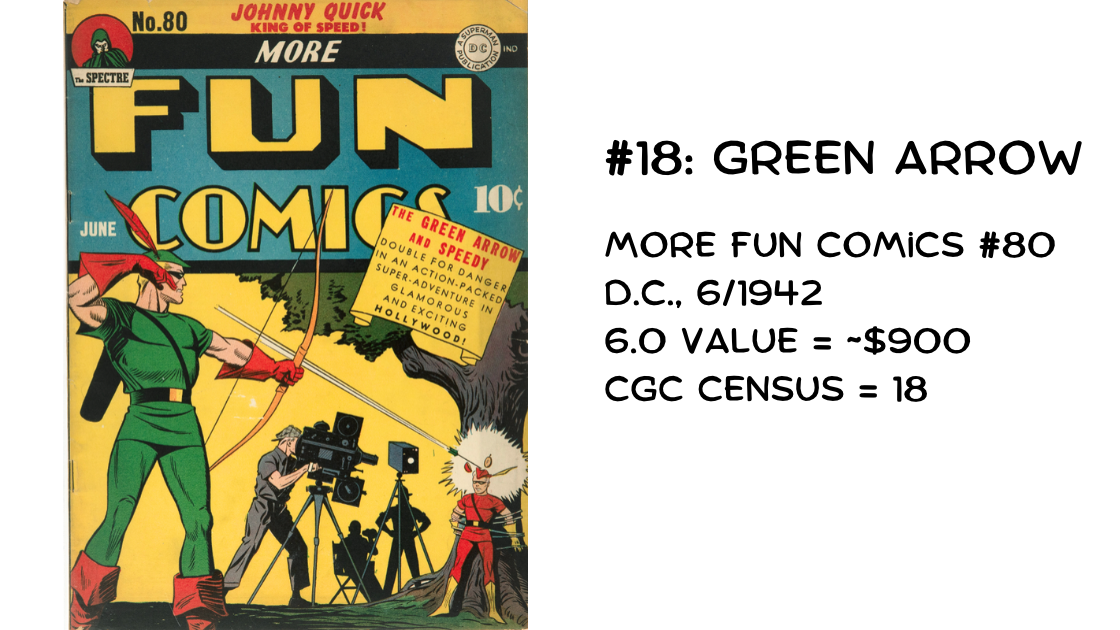
At 18, the Green Arrow does his best William Tell impression in More Fun Comics #80. Though Speedy survived this reckless stunt, I wouldn't be surprised if the resulting trauma contributed to his heroin addiction uncovered almost 30 years later in Green Lantern #35.
This is the only book on the list that can be acquired for under $1,000 at a CGC 6.0.
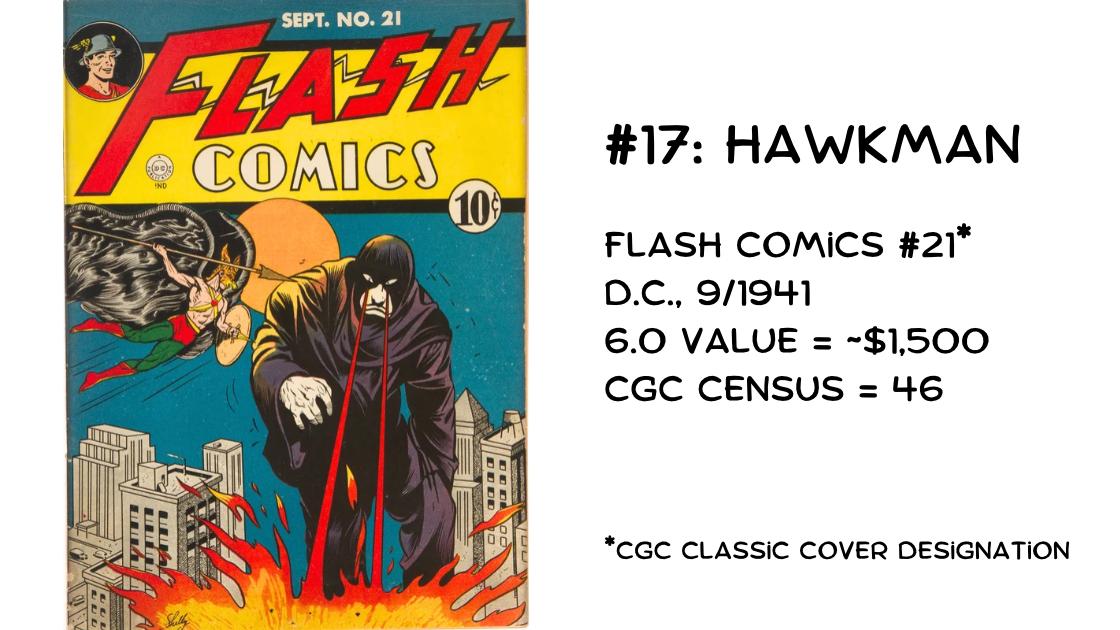
Hawkman confronts Egon in Flash Comics #21. The alien child has been prematurely hatched by an evil scientist who has manipulated him since birth. The orange moon highlights the moment just before action: Hawkman’s spear vs. Egon’s eye beams.
Art lovers, take note of Hawkman's ethereal wings rendered by Shelly Moldoff. True treasures of the Golden Age.
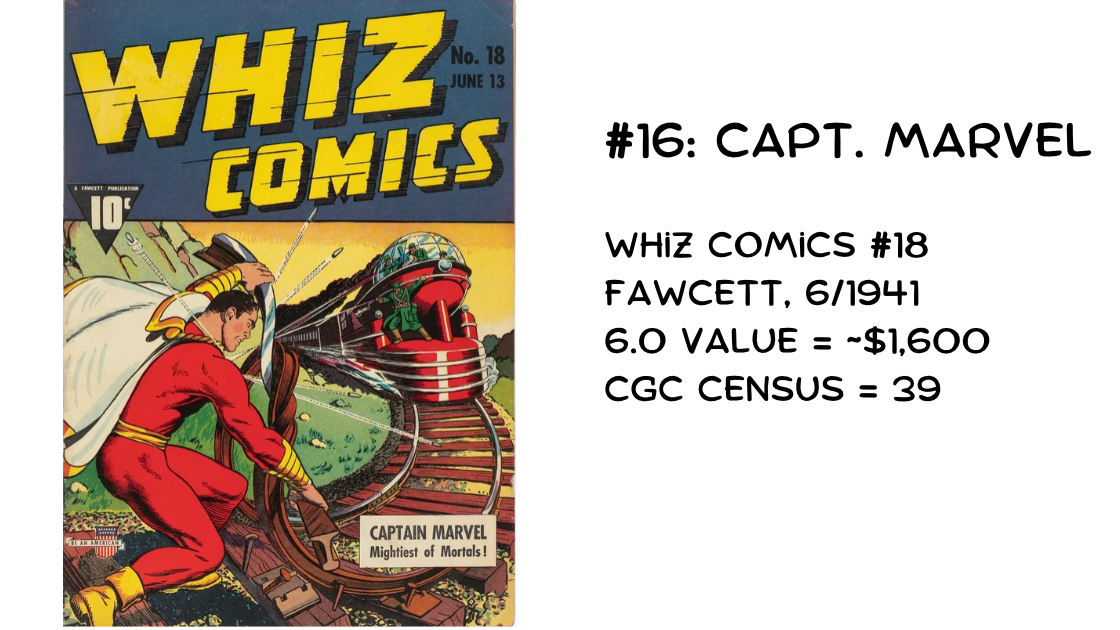
For being the most popular comic book character of the 1940s, Captain Marvel is underrepresented in discussions of great cover art. Granted, many of the covers were geared toward younger kids, but I'd like readers to consider Whiz Comics #18.
C.C. Beck renders a dynamic scene. The Big Red Cheese rips and twists the track to derail the oncoming military train. It's a terrific example of the larger-than-life action that made Captain Marvel so popular.
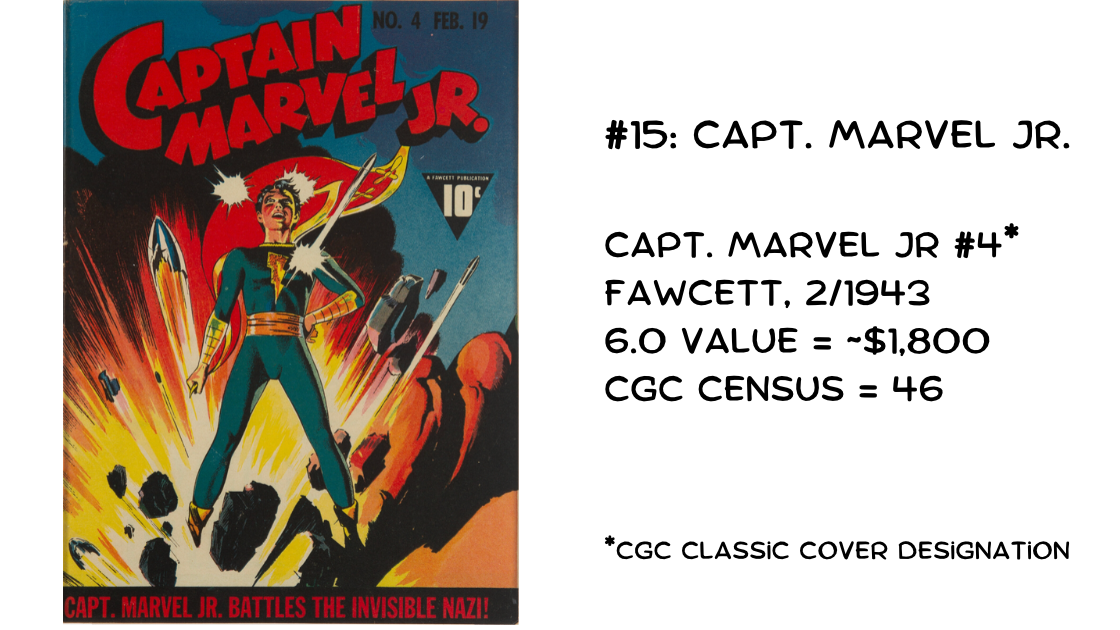
Next up, and just slightly more expensive, is Captain Marvel Jr. #4. Not only is this the best cover of the young hero, it's legitimately one of the best covers of the Golden Age.
Mac Raboy draws the Little Blue Cheese standing boldly amidst explosions and debris. Divine.
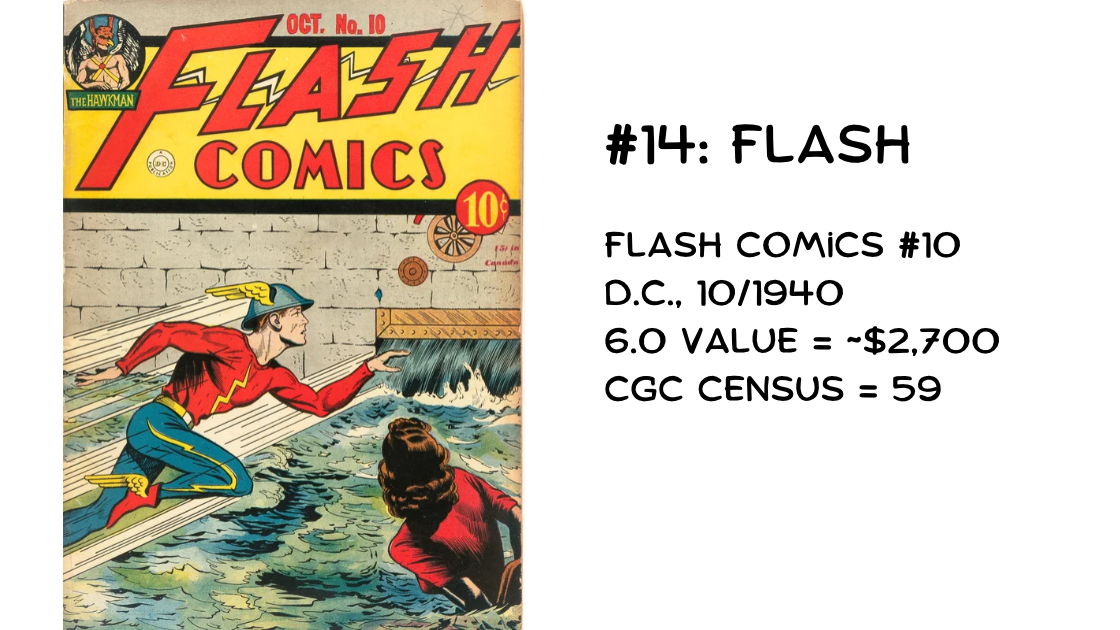
We return to Flash Comics, but this time it's #10, featuring the titular hero. Interestingly, it's more difficult to find a great cover of Flash in comparison to Hawkman.
Nonetheless, Shelly Moldoff's talent comes through again in this riveting cover, featuring Flash darting to close the floodgate to save a distressed woman. The sense of urgency and movement makes this one stand out.
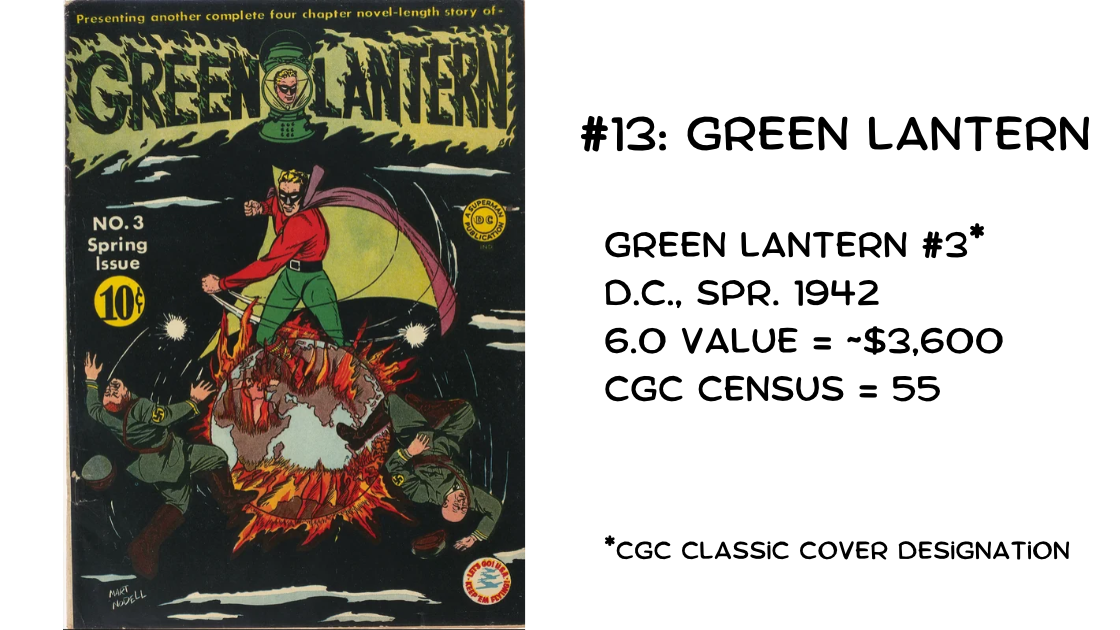
For the 13th spot in the countdown, we stay with D.C. Green Lantern #3 features our hero punching two Nazis with one swing, a burning globe between them.
It's the vibrant green against the black background that makes this Martin Nodell cover stand out. The bold colors and straightforward action give it an unmistakable Golden Age feel.
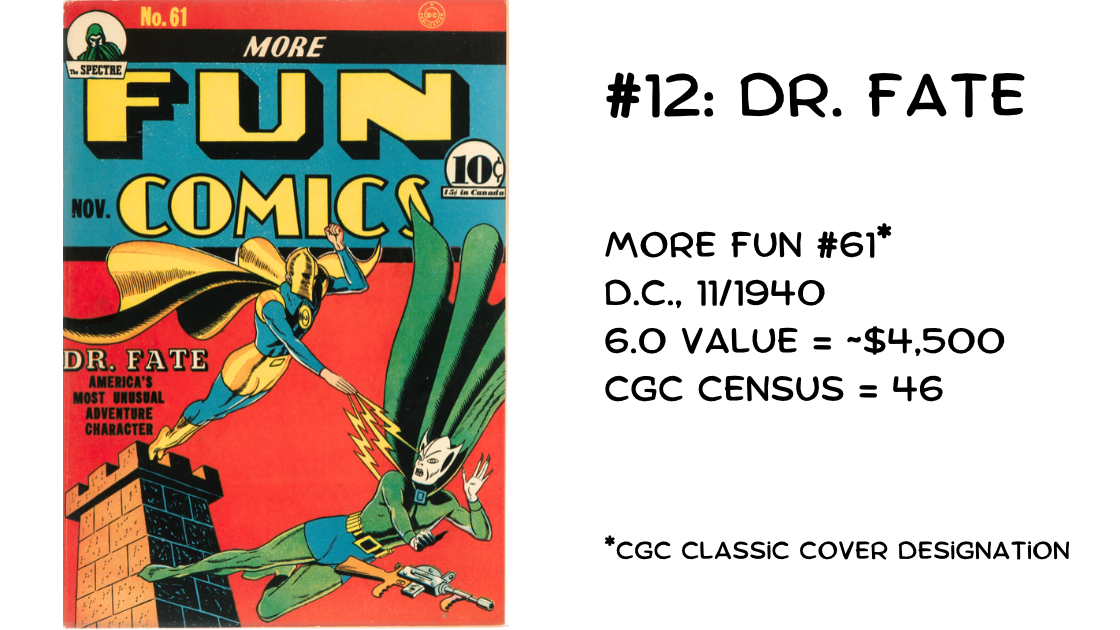
Some superheroes just lend themselves to great covers. Dr. Fate is one of them. The blue and yellow costume, the sleek helmet, the majestic cape. I had difficulty picking across several amazing issues, but More Fun Comics #61 is certainly worthy of the selection.
Dr. Fate, soaring across the sky, shoots lightning bolts at the machine-gun-wielding creature. What's not to like?
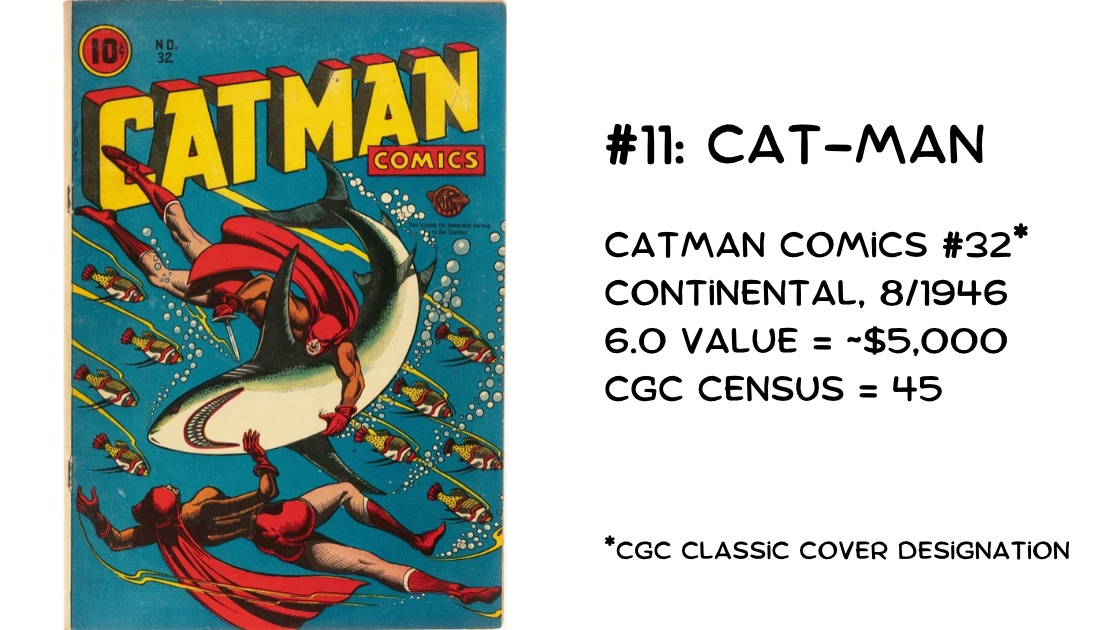
How does a lesser-known character like Cat-Man come this close to cracking the Top 10? He had the good fortune to be drawn by the legendary L.B. Cole. His stylized and easily recognizable work puts the feline hero up there among the best.
I chose Cat-Man Comics #32 among several deserving candidates. The swirling underwater scene is one for the ages.
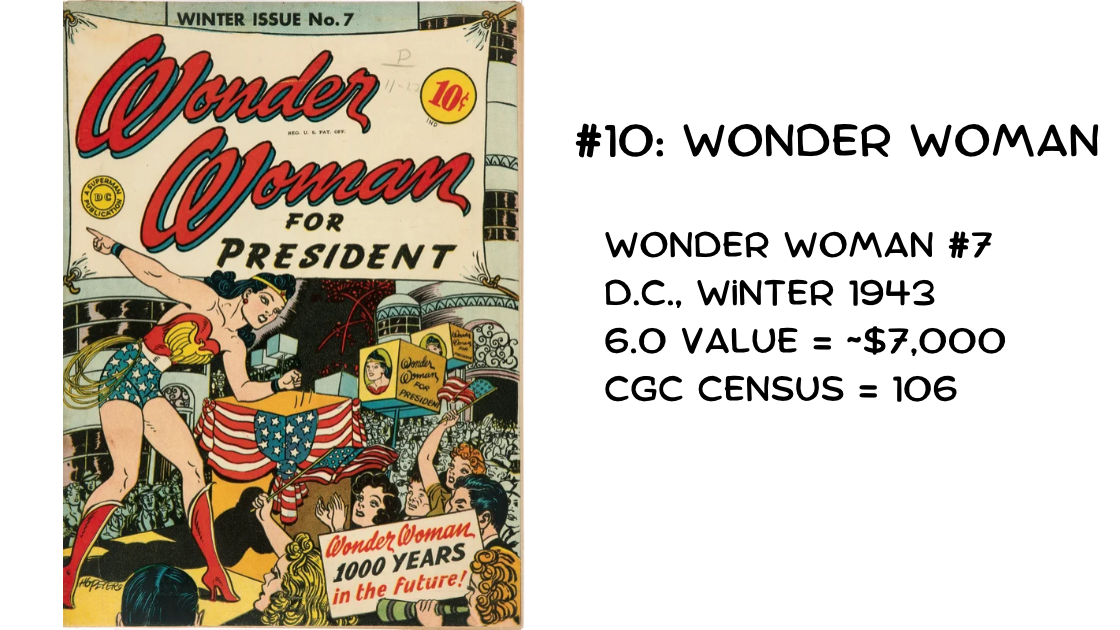
At the tenth spot, we have the first lady—or should I say president—of the Golden Age. In this H.G. Peter cover, Wonder Woman hits the campaign trail, surrounded by eager supporters.
Notice the sign: "Wonder Woman, 1,000 Years in the Future." I'm going out on a limb here, but I'm guessing the United States will have at least one woman president by 2942!
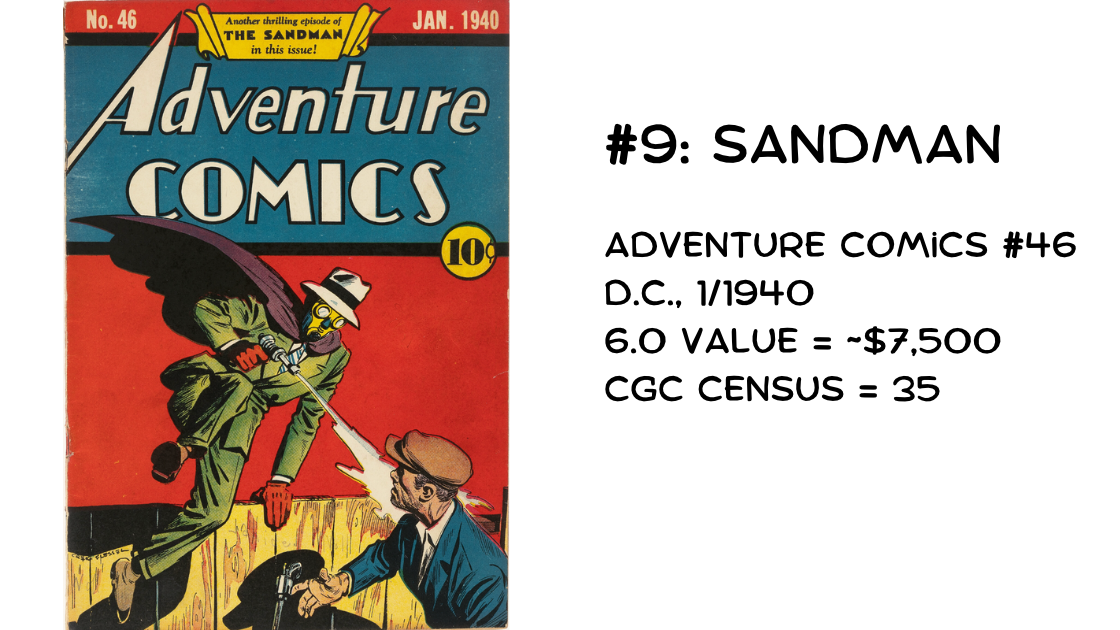
The Sandman was born for great covers. Adventure Comics #46 from early 1940 is as good as any of them.
The bespoke suit and gasmask get me every time. Here, the noir character leaps over the fence and says night-night to the gun-toting thug. The hero's movement stands out in Creig Flessel's uncluttered scene.
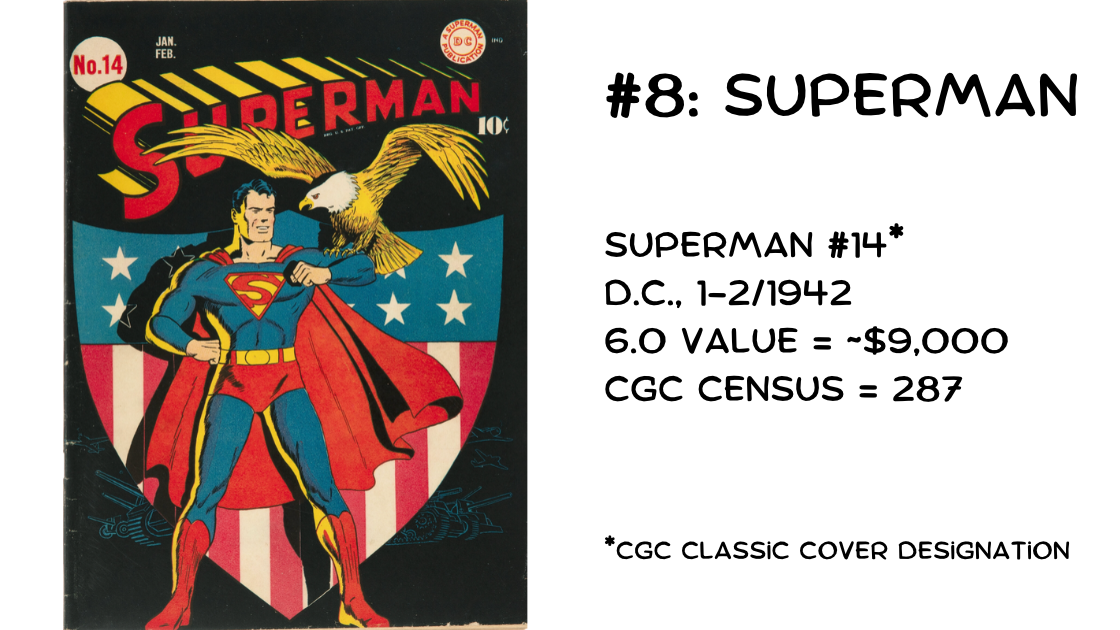
Superman #14 grabs your attention immediately. It is among the most striking covers of the Golden Age: Superman standing confidently in front of an American shield with an eagle perched on his arm.
Plus, the logo, the faint tanks in the background, and the black cover all come together to create one of the true gems of the period.
Note the CGC census for this issue: nearly 300, making it the most common book on this list. Its relatively high census count helps explain why it is less expensive than some of the other books featured here.
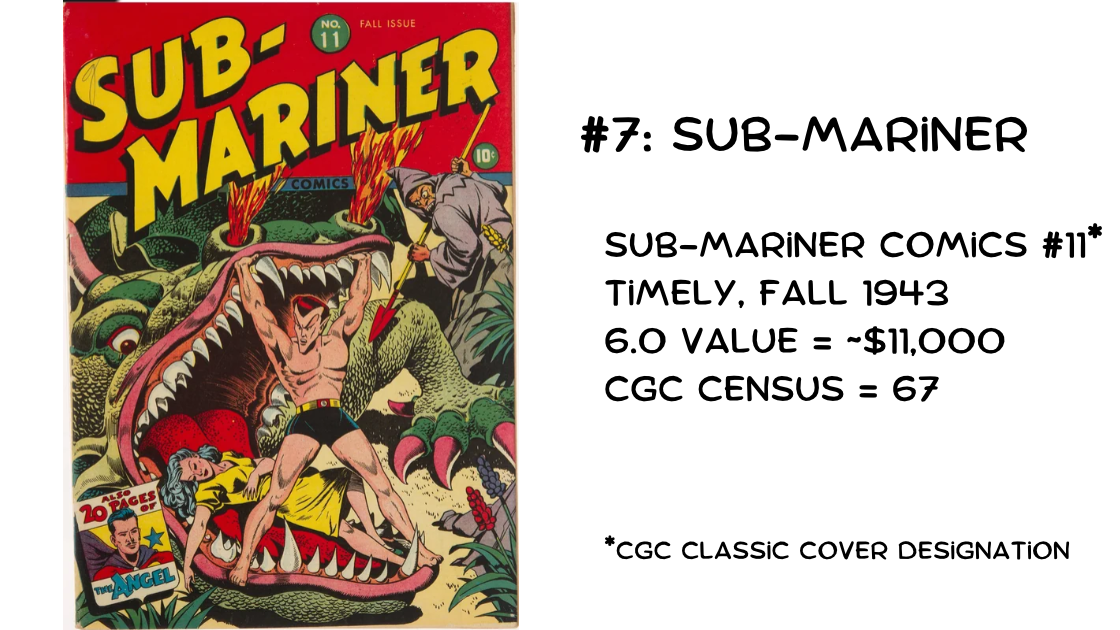
No doubt about it, Timely (later known as Marvel) had fewer big Golden Age characters compared to D.C. But the publisher had a secret weapon: cover artist Alex Schomburg.
His over-the-top, action-packed style translated into dozens of his covers receiving "Classic Cover" designations from the Overstreet Price Guide and CGC.
In Sub-Mariner Comics #11, the aquatic hero wedges himself between the jaws of a fire-breathing dragon. Note, we have crossed the $10,000 barrier.
We have no #6 because two books are tied for the fifth-place spot. Both are drawn by Alex Schomburg.
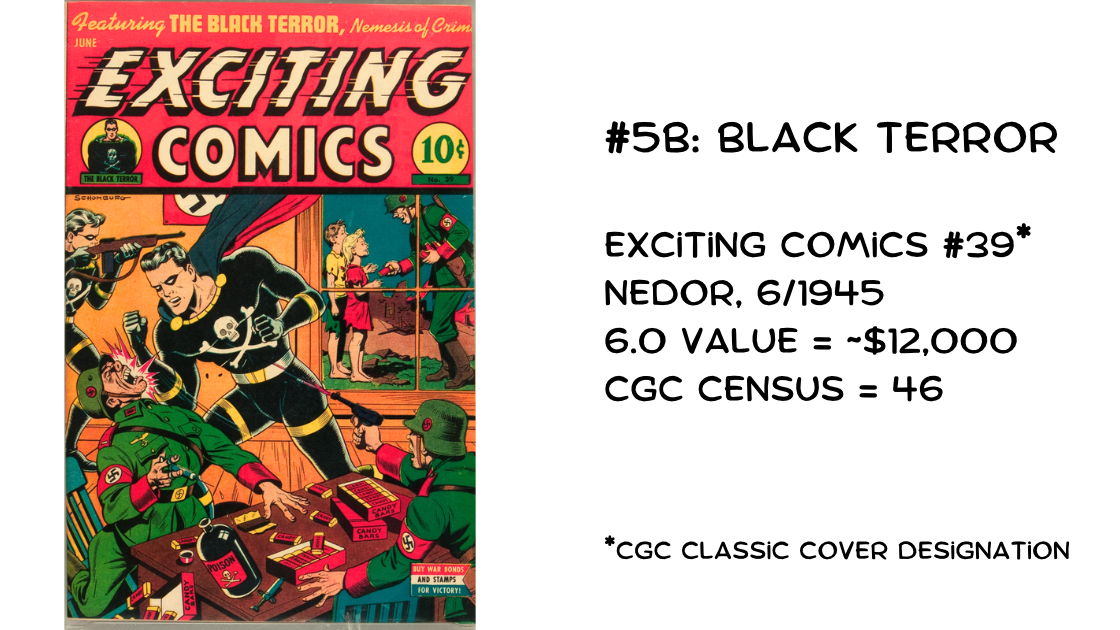
The first features a lesser-known character, the Black Terror, from a lesser-known publisher, Nedor. Exciting Comics #39 follows a similar trope of the period: the hero hitting a Nazi.
To fully appreciate this cover, you've got to look more carefully at what's going on. The punched Nazi was injecting candy bars with poison. In the background, through the window, we can see another Nazi. He’s smiling while handing out the tainted confection to war-ravaged children. Dastardly.
Schomburg's ability to pack so much detail into a single cover is one of the reasons his work remains so popular with collectors.
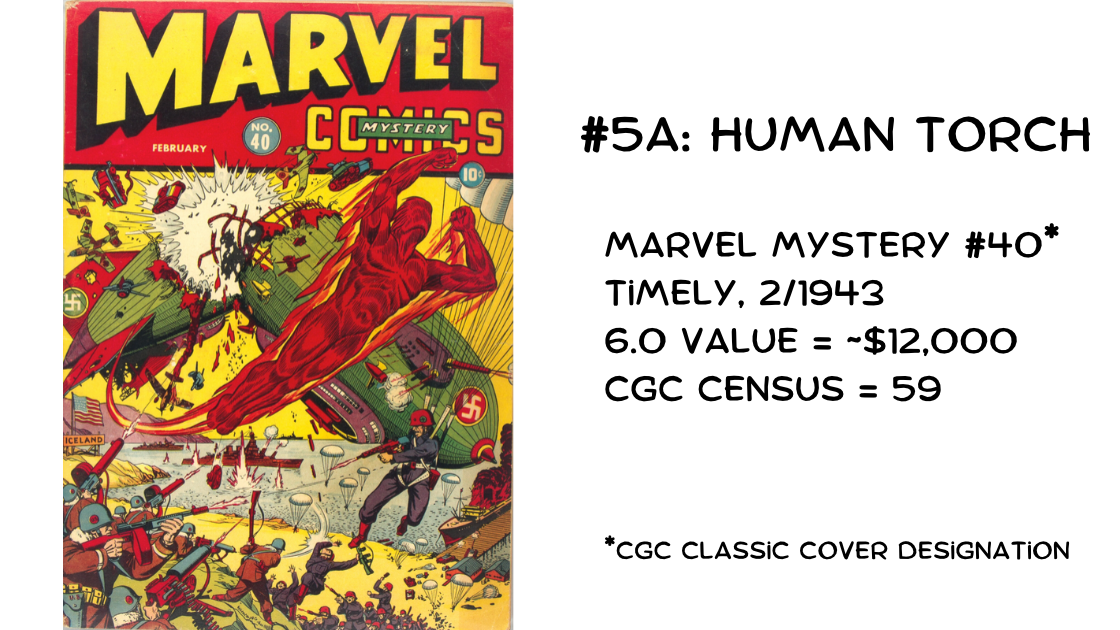
Second up in the fifth spot is what I consider to be the pinnacle of World War II superhero covers: Marvel Mystery Comics #40. Schomburg's Torch blazes through the Zeppelin, subjecting dozens of Nazis and their vehicles to a fiery demise as they fall helplessly from the sky.
It's over-the-top Schomburg at his finest.
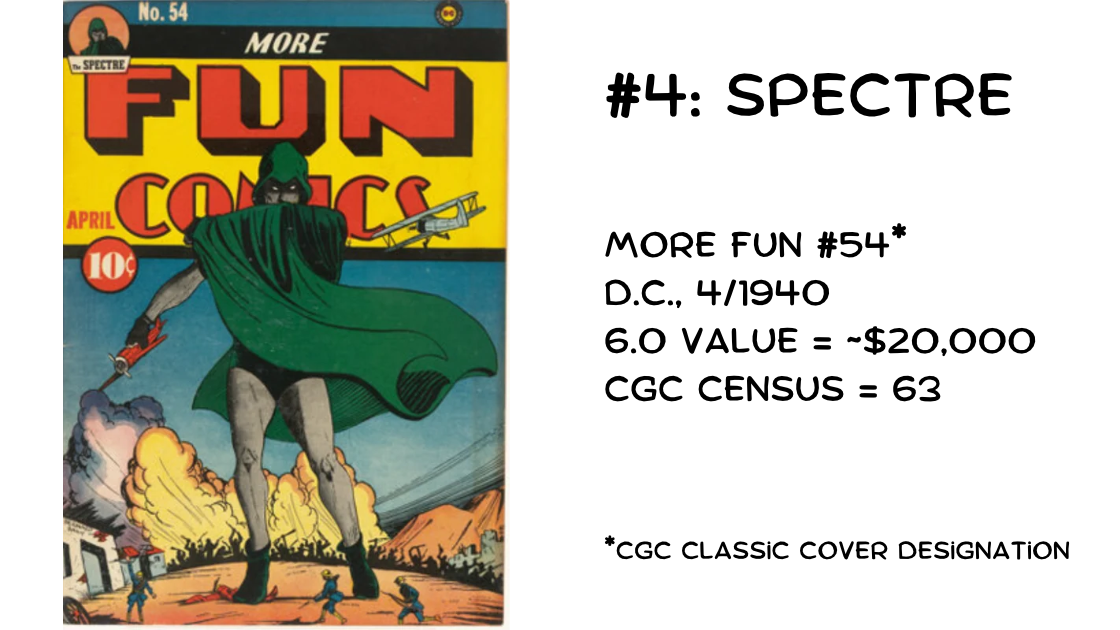
Breaking up the Schomburg lovefest momentarily is Bernard Baily's masterpiece: More Fun Comics #54.
This sublime cover features a giant Spectre snatching prop planes from the air while a war wages on behind him. The dramatic pose, the cape, the cowl, and glowing eyes put this cover among the very best of the Golden Age.
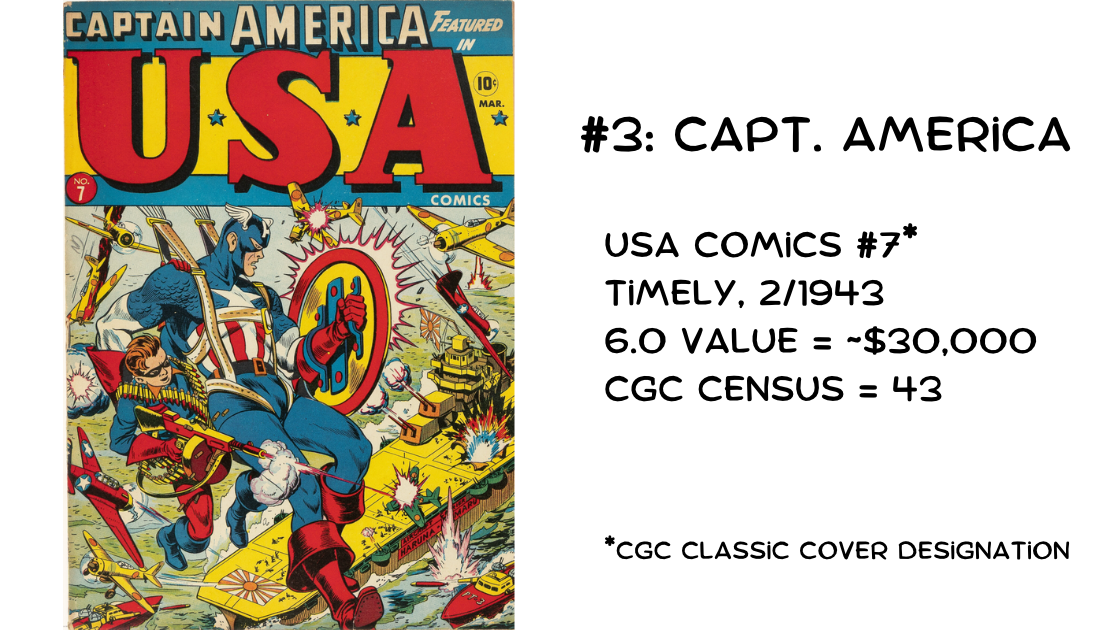
At the third spot, we have our last Schomburg cover, this time featuring Captain America in USA Comics #7.
From a parachute, Cap and Bucky take on a Japanese aircraft carrier, enemy planes, and a barrage of bullets and missiles. Cap plays defense with his shield while Bucky fires his machine gun.
Adding fuel to the fire is how difficult this book is to find in grade. While 43 are currently listed on the census, only 27 are Universal. Among those, one is listed at a 6.0, with only six higher! A 6.0 will set a collector back about $30,000.
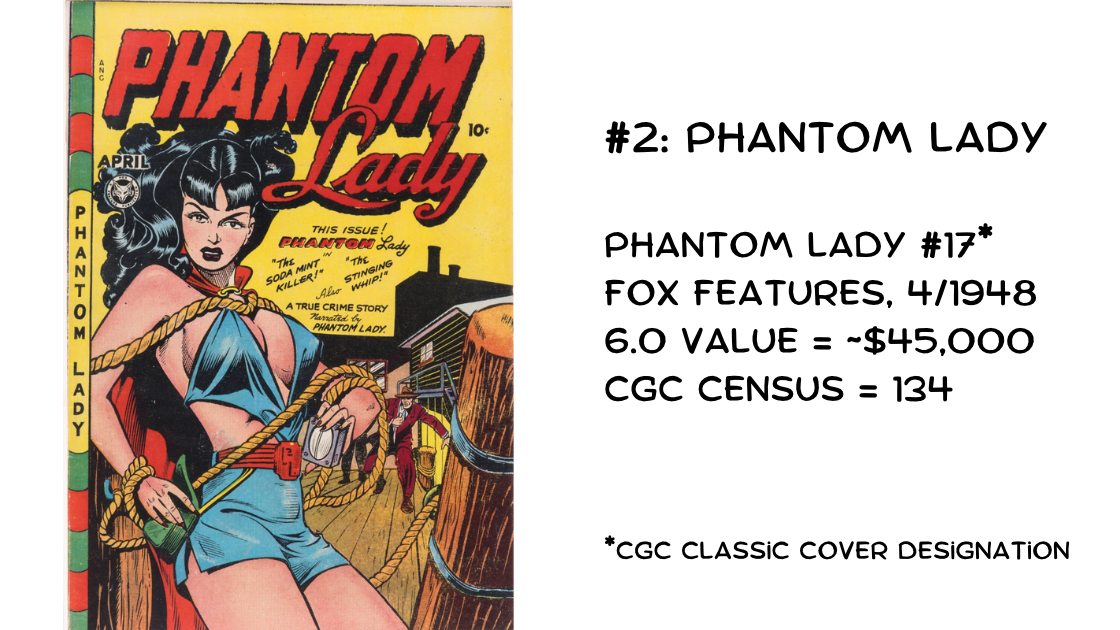
We're going to change gears here with a cover that transcends the character's star power. This is Phantom Lady #17 from Fox Feature Syndicate.
The cover is credited to Matt Baker, widely considered the best romance artist of all time. Here, the Phantom Lady is provocatively posed as she attempts to free herself from bondage.
According to a Heritage listing, in the 1954 book Seduction of the Innocent, Frederik Wertham referred to the cover as a "sadist's dream." As opposed to serving as a warning to comic book collectors, the publicity instead stoked the flames of collector desire.
In CGC 6.0 condition, the book sells for around $45,000.
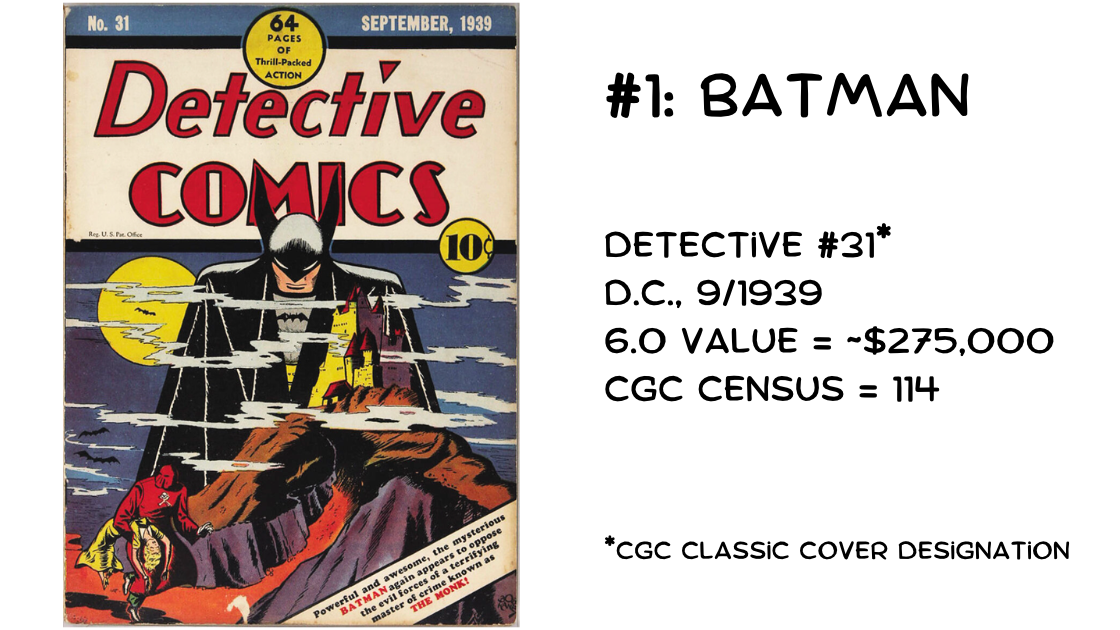
The distance between the first and second book on this list is vast regarding demand and price. Detective Comics #31 is the clear front-runner of Golden Age superhero covers.
A 6.0 copy will run a collector north of a quarter million dollars. It's only the third cover appearance of the Golden Age character who is most popular today: Batman. It features an image that best represents the brief Dark Knight period of the Caped Crusader. A menacing Batman looms over the moon-lit scene. The red-robed, damsel-carrying villain is woefully outmatched in this issue.
This is not only a great classic cover issue; it ranks as one of the top 10 comic books of all time. It’s incredibly rare in grade: two in 6.0 and only six higher.
Two More Characters Worth Mentioning
Let's go back to the question raised earlier in the list. I teased 20 characters, but my list only contains 18 books. What gives? It's due to a rules violation and an interesting piece of Golden Age trivia.
I was looking for the best cover of Plastic Man, a popular character from Quality Comics. The problem: in my opinion, one cover clearly stands out from the rest.
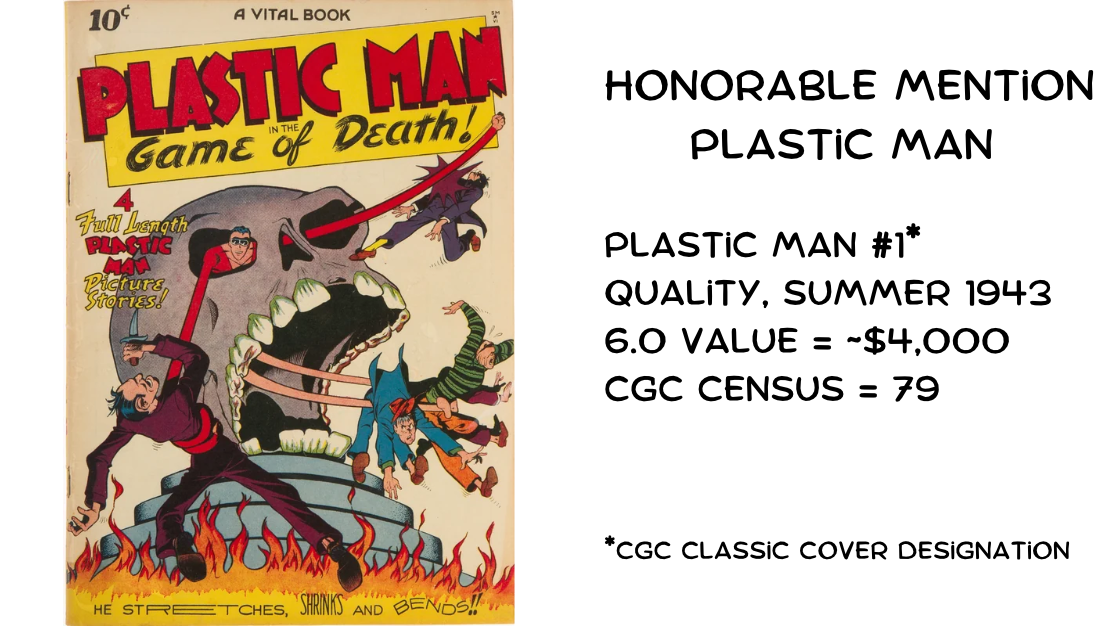
It's Plastic Man #1, which features our elastic hero punching and apprehending criminals with his body inside of a flaming skull and his limbs stretching out of it.
Because this excellent cover is also a first issue, it's disqualified, but I include it here as an honorable mention.
Last, I was hopeful to find a Golden Age Aquaman cover to include in the list. I couldn't remember seeing a Golden Age cover, so this would be a fun quest.
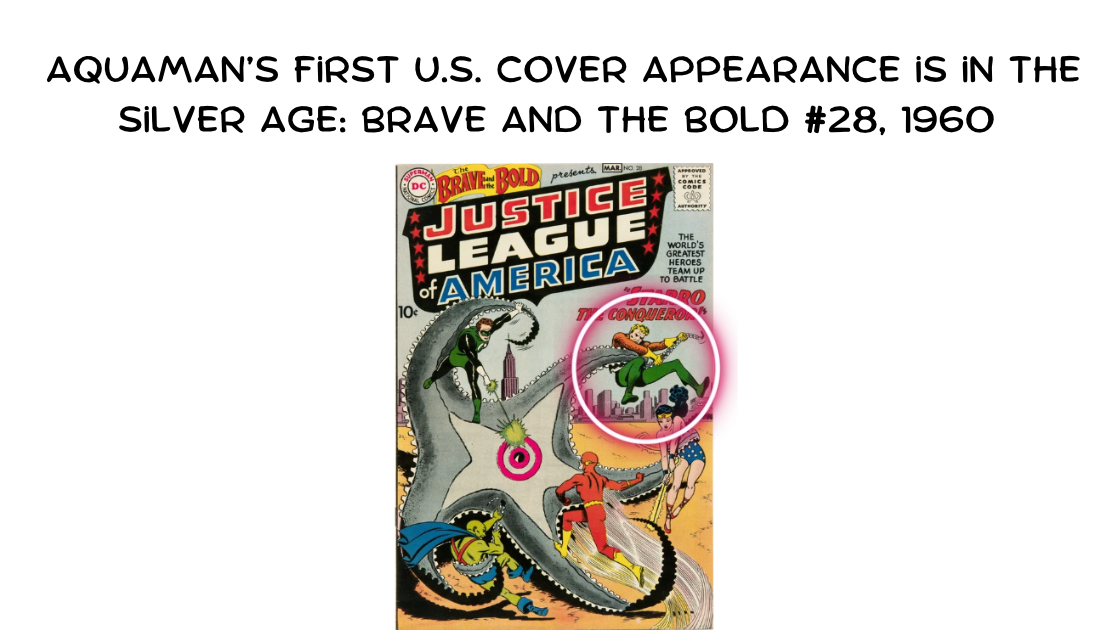
There's a good reason. Despite Aquaman first appearing in More Fun Comics #73 in 1941 and appearing in dozens of backup stories throughout the Golden Age, he never once appeared on the cover. In fact, it didn't happen in U.S. comics until 1960—the early Silver Age—via Brave and the Bold #28.
Concluding Thoughts and Value
Some readers may be struck by the price disparity among the superheroes' best covers: from under $1,000 to over a quarter million. Does that mean the cheapest issue—Green Arrow, More Fun Comics #80—is the best deal and the most expensive—Batman, Detective Comics #31—is the worst?
No. 'Tec 31 is rightfully one of the most sought-after and expensive books in the hobby. Even casual fans can appreciate its significance and striking cover art. Whereas, I'll be honest, it was difficult to even identify a Green Arrow cover that was good. Plus, the character is far lower on the superhero pecking order.
That being said, there are a few comic books that stood out to me as being relatively cheap and perhaps a good value.
For as big a character as Captain Marvel, and as good as the art is for Whiz Comics #18, I'm certainly a buyer at $1,600. An even better deal is Captain Marvel Jr. #4. I've heard many seasoned collectors talk about this cover as one of the best of the entire Golden Age. You don't hear those kinds of glowing reviews for many other books selling for under $2,000.
Another value, to my eye, is Flash Comics #21, featuring Hawkman. Only $1,500 for that classic cover. Count me in. But it's not just Flash Comics #21. Look for any cover featuring Hawkman drawn by Shelly Moldoff. With rare exception, they are magnificent, and none of them is prohibitively expensive for the Golden Age.
What's a bad value? That's hard to say. Personally, I'm not a fan of Phantom Lady #17. I'd have a hard time paying current prices for the book. I think it pales in comparison to many other covers drawn by Matt Baker. That said, many people swear the book is the very pinnacle of good girl art. Apparently, I'm in the minority.
And that brings me to my last point. If you want to determine good or bad value, you really have to have your finger on the pulse of collectors' interest, not necessarily your own. However, if your goal is to acquire books that satisfy your tastes and your soul, then lean into what you like.
Study as many covers as you can and buy what resonates with you. I've had a few books in my collection worth tens of thousands of dollars that I couldn't sell fast enough, and I've had others worth hundreds of dollars that may never leave my personal collection.
Let articles like this one, or the Classic Cover designations by Overstreet and CGC, help introduce you to books, but don't let us replace your own sensibilities.
Methodology Notes
How did I choose the 20 characters for consideration?
At least half are no-brainers: the big D.C. and Timely (Marvel) superheroes are known to even casual comic book fans today, like Batman or Captain America.
Several spots are more controversial. I erred on the side of publisher diversity. For example, I included Captain Marvel Jr. (Fawcett) over Robin (D.C.), as D.C. was already well represented in the pool.
This isn't intended to be a definitive ranking of the 20 most important Golden Age superheroes. Rather, it's my selection of 20 well-known characters that provides a good cross-section of the era's publishers and artists.
How did I choose the best cover?
I leaned heavily on CGC's Classic Cover designation. If a character had multiple Classic Cover designations, I went with my favorite. By and large, the cover I chose also happens to be the most expensive Classic Cover for that hero, but not always.
Some characters, like Green Arrow and Captain Marvel, had no covers designated as Classic. Out of necessity, I went with my favorite cover.
Ultimately, these selections reflect my own judgment. The designations were a useful starting point, but I wanted to consider the covers themselves rather than simply defer to someone else's choices.
How did I determine census counts and prices?
I looked up the census counts for each book at CGC.com and the prices at GPAnalysis.com in mid- to late November 2026. The CGC counts include all copies.
Estimating the prices of each Golden Age book was not straightforward. Because of their rarity, sales data are often sparse, meaning it was unusual to find a recent CGC 6.0 sale for most books. Consequently, pricing in this article almost always required extrapolation. I used relatively recent sales at other grades to inform my estimates of CGC 6.0 prices.
Why exclude first appearances and first issues?
I excluded first appearances and first issues because I wanted to separate the appeal of the cover art from the historical significance of the comic itself. Many collectors, myself included, have difficulty separating familiarity with an iconic key issue from an appreciation of its artwork.
This rule isn't perfect, as the Plastic Man example illustrates, but it forces collectors to consider books beyond the most recognizable.
Acknowledgements and References:
All images of comic books from Heritage Auctions (HA.com)
Census data from CGC.com
Price estimation from GPAnalysis.com
Heritage listing of Phantom Lady #17 providing Wertham quote: https://comics.ha.com/itm/golden-age-1938-1955-/superhero/phantom-lady-17-fox-1948-cgc-vf-85-pink-pages-this-classic-matt-baker-bondage-cover-is-on-everybody-s-want-list-cite/a/804-5311.s
Additional information about the first cover appearance of Aquaman: https://boards.cgccomics.com/topic/507206-what-was-aquamans-first-comic-cover/