Are WHITE Pages RARE?
I was scanning through eBay listings using the search “Rare Comic Books.” Over and over again, I came across a common marketing theme: “Rare WHITE-Paged Comic.”
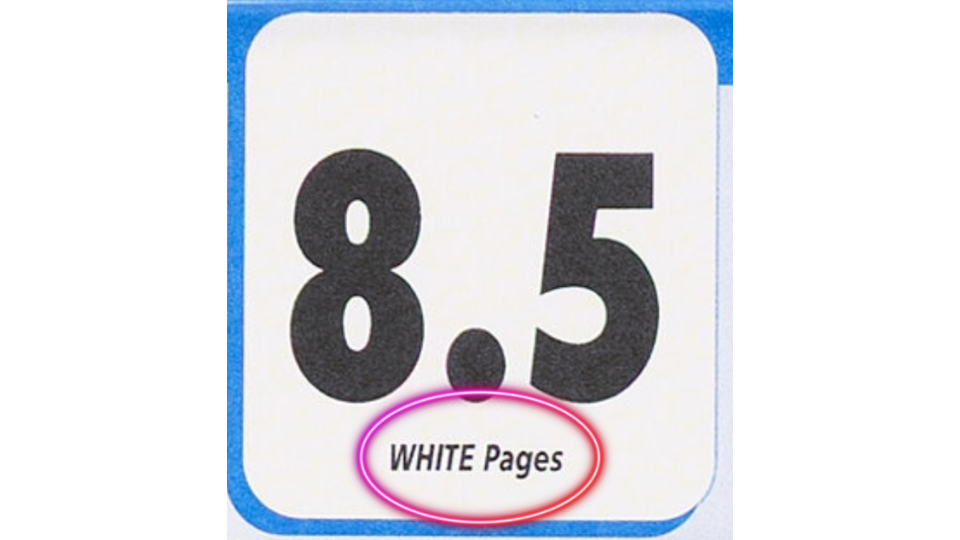
If anything irks me in life, it is when somebody calls something rare when it is not. And I feel compelled to point it out. Why I feel this is my cross to bear, I can’t tell you. What I can say is that I’ll go to great lengths to investigate claims of rarity.
In fact, I analyzed over 3,000 listings of third-party-graded comic books to give the readers of the Collectors Hub an empirical response to the titular question.
But before we get to the data, we need to answer a more basic question:
What exactly does it mean for a comic to be “rare” with White pages?
There are several different kinds of rarity when it comes to comic books. A particular issue can be rare because few copies exist. That’s absolute rarity. A particular copy in high grade can be rare because few surviving copies have reached that grade or higher. That’s one type of conditional rarity. And, of course, White-page quality can be rare because only a small percentage of surviving copies have that page quality. That’s another type of conditional rarity.
These distinctions are important because a comic can be relatively common overall but have an unusually small percentage of copies with White pages. In that case, I’m perfectly comfortable calling the White-paged copy conditionally rare.
For instance, if 100,000 copies of a comic exist but only 100 have White pages, then I would be okay with someone claiming the (conditional) rarity of the particular copy. However, if 25,000 copies of the book have White pages, then I’d put their claim squarely in the overhyped camp.
In other words, the percentage of White-paged copies matters, but so does the total number of copies that exist. A low percentage doesn't necessarily mean a White-paged copy is scarce, just as a relatively high percentage doesn't necessarily mean White pages are common in absolute terms.
So, going back to the eBay books, I was curious. Just how rare are the White-paged comics so eagerly promoted?
The short answer is: it depends dramatically on the age of the comic.
In my sample, White pages are common in Copper-Age books, less common in Bronze-Age books, scarce to extremely rare for Silver-Age books, and extremely rare for Golden-Age books.
But how did I arrive at that conclusion?
How to Investigate the Problem?
Right off the bat, I knew that I would have to account for comic book age. From personal experience, it seemed like comics from the ’30s and ’40s tended to have poorer page quality. And comics from the ’80s and early ’90s tended to have better page quality.
I also knew that in the ’90s, publishers en masse transitioned to “slick” paper—pages designed to have a much, much longer shelf life. It’s rare for books from the ’90s and later not to have White pages, so comics from the mid-1990s forward were not considered for analysis.
For these reasons, I analyzed page quality by four eras: Golden Age, Silver Age, Bronze Age, and Copper Age. I selected several of the biggest keys from each era to give readers a sense of White-paged rarity.
This task would be easy if the CGC census allowed for filtering by page quality, which will hopefully be coming soon, but alas, it is unavailable at the time of this writing.
Consequently, I had to turn to the next best, but certainly less precise and more time-consuming, option of combing through the Heritage Auction archives.
Amazing Fantasy #15 LIstings from the Heritage Archive

A big shout-out to Heritage Auctions here, as they provide an easily navigable way to see and examine their past sales. Nevertheless, I had to briefly examine each of thousands of listings to compile the data.
For each issue, I examined the most recently sold, third-party-graded copies listed by Heritage, reviewing up to 204 listings—the maximum number displayed per page. More than 95% of the copies in my sample were CGC-graded. Further, if there was an unusual finding—for example, the huge discrepancy in the percentage of White pages for Amazing Fantasy #15 vs. The Incredible Hulk #1—I examined all available Heritage listings of the respective issues.
I did not examine restored comic books, as sometimes their interior pages are artificially lightened. Nor did I include lots that were one or more interior pages (i.e., PG or NG).
For the average page-quality percentages by era, I averaged the percentages for each book, giving every comic equal weight regardless of how many copies were examined.
There are many limitations to my methodology. The results and interpretation here should be considered in broader strokes than as definitive findings. One important distinction: these percentages represent the proportion of graded copies in my Heritage sample that had White pages. They should not be interpreted as saying that the same percentage of every surviving copy of a particular comic has White pages.
There is likely selection bias in the Heritage data. The books that make their way into major auction houses may not perfectly represent the broader graded population, much less the page-quality distribution of ungraded copies. In fact, it is possible that particularly attractive copies—including those with desirable page quality—could be disproportionately represented.
That's one reason I don't want to oversell the precision of these numbers.
What I am looking for here are broad patterns.
And the patterns are interesting.
For purposes of this article, my rough rule of thumb is that the upper limit of “scarce” is around 2,000 copies, the upper limit of “rare” is about 200 copies, and fewer than 50 enters the “extremely rare” realm.
At a Glance
of White Pages
You might be asking, why are Silver-Age White-paged issues denoted as Scarce to Extremely Rare while Golden-Age issues are dubbed Extremely Rare? The proportion (6% vs. 5%) is extremely similar. It’s due to the denominator, which I’ll flesh out more later in the article.
In other words, the percentage of White pages tells only part of the story. If a comic has tens of thousands of surviving copies, even a relatively small percentage of White-paged copies can still mean thousands of examples exist. If only a few hundred copies survive, that same percentage can translate into only a few dozen White-paged copies.
Also of note, these numbers aren't meant to be definitive measurements of the entire comic-book population. They are intended to give us a sense of how unusual White pages are within graded copies of major keys from each era. Further, within keys for each era, there is considerable variability.
And with that disclaimer out of the way, let's look at the books.
Findings
Copper Age
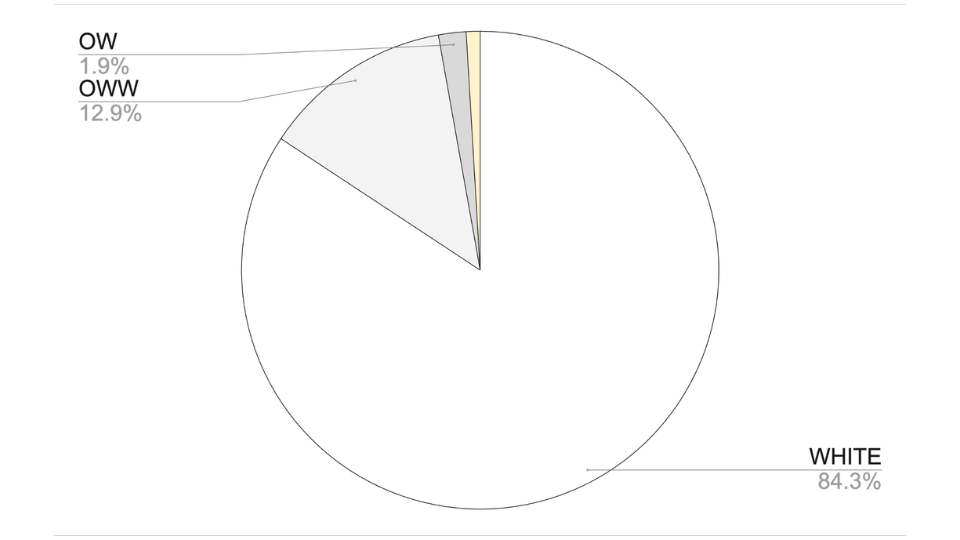
The vast majority of graded comics from the Copper Age have White pages from my sample. Of the books evaluated, Teenage Mutant Ninja Turtles had the lowest percentage, but still had White pages in nearly ⅔ of all copies.
Out of all copies evaluated from this era, none had worse page quality than Cream to Off-White. I’m sure a few copies exist with poor page quality, but they are likely few and far between, and for many of these issues, they may not be valuable enough to warrant third-party grading.
Main Takeaway
White pages are the norm for Copper-Age books. Having White pages does NOT make a copy substantially rarer. And, typically, Copper-Age comics were produced in high numbers and the vast majority of them survive.
In other words, if you see a Copper-Age comic advertised as a “Rare White-Paged Copy,” I'd be skeptical.
Bronze Age
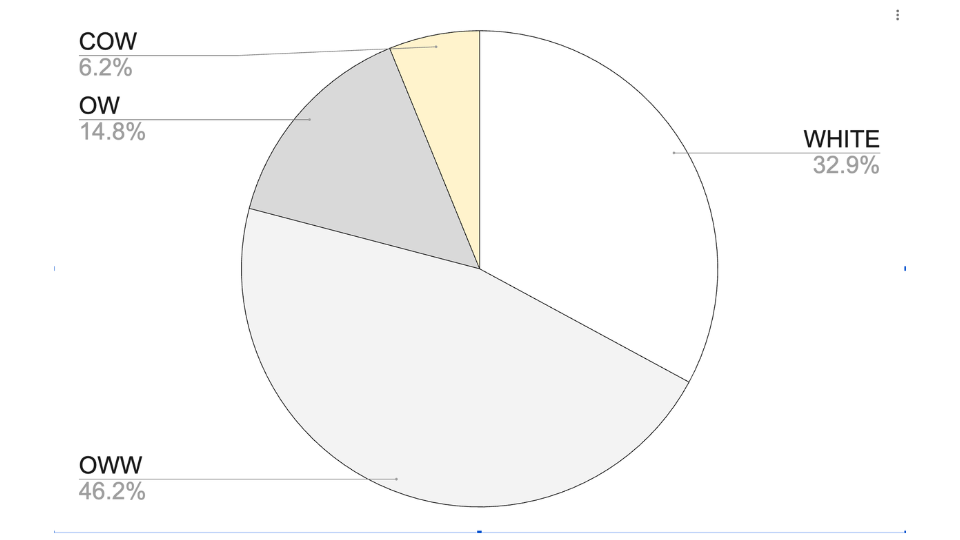
Certainly more variation here.
The lone DC title I examined closely—House of Secrets #92, the first appearance of Swamp Thing—had merely 14% White pages. I quickly looked at other DC keys from the era—not listed here—and White pages appeared at a much higher percentage (25%+), so perhaps House of Secrets #92 is an aberration. The Marvel keys of this era appeared to have about ⅓ of their copies as White pages.
So we are definitely seeing an uptick from the Copper Age. White pages are more difficult to find.
Nevertheless, Bronze-Age comics aren’t typically rare overall. For example, over 20,000 copies of Hulk #181 have been graded by CGC, and there are likely as many or more that have not been graded, so let’s speculate that 40,000 exist.
Assuming that about ⅓ of 40,000 have White pages, we’re still looking at well over 12,000 copies with White pages. And, even if my percentage-of-White-page estimate is dramatically too high due to selection bias in sampling, and merely ⅙ of all Hulk #181s have White pages, we’re still looking at 6,000-plus copies: uncommon but not scarce, and certainly not rare.
Main Takeaway
White pages aren’t the norm, but they aren’t unusual by any stretch. By and large, I would be skeptical if anyone lists a Bronze-Age book as “Rare in White Pages.” Certainly check the claim.
That doesn't mean White pages aren't desirable; they are just not rare for most Bronze-Age keys.
Silver Age
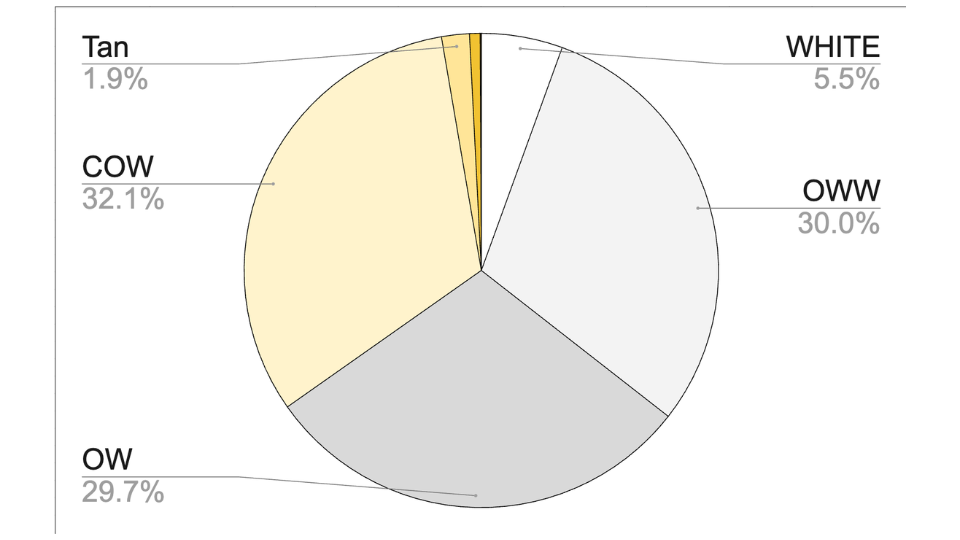
This is where it gets interesting.
Finding WHITE pages for the Silver-Age keys is much, much tougher than in the earlier ages, at only about 5.5% overall.
The overall average hides some interesting variability.
We see less than 1% White pages to almost 20%!
Even more interesting is the difference between Amazing Fantasy #15 and The Incredible Hulk #1.
Both were published in the same year by the same publisher, but it’s ridiculously hard to find a White-paged AF #15 (2% White Pages), while it’s relatively easy to find a Hulk #1 with White pages (18%).
That's a ninefold difference in the observed percentage. That's so bizarre. I may have to dig into this more. Did Marvel use a better batch of paper for Hulk #1 than other keys at the time? Or was something else going on with the paper, printing, distribution, or storage of these books?
I don't know.
And that's something I find most interesting about these data. Two books can come from the same publisher, the same year, and roughly the same period of production, yet have dramatically different page-quality profiles.
Let’s extrapolate to think about how many White-paged AF #15s and Hulk #1s might be out there. Bear with me because I’ll also be making some pretty large assumptions regarding the relationship between the number of comic books graded by CGC and the actual number of comics that exist. I’ve heard CGC President Matt Nelson suggest about 50% for silver-age keys, so I’ll run with that estimate.
Overall, Hulk #1 is less prevalent. As of this writing, about 2,400 have been graded by CGC, and let’s assume that 5,000 copies exist overall. Amazing Fantasy #15 has about 4,300 copies graded by CGC, and let’s assume 10,000 copies exist.
If 18% of Hulk #1s have White pages, that would be about 900 White-Paged copies, vs. Amazing Fantasy #15 with approximately 200 White-Paged copies due to the low 2% of White-paged copies.
The Tale of Two 1962 Marvel Issues
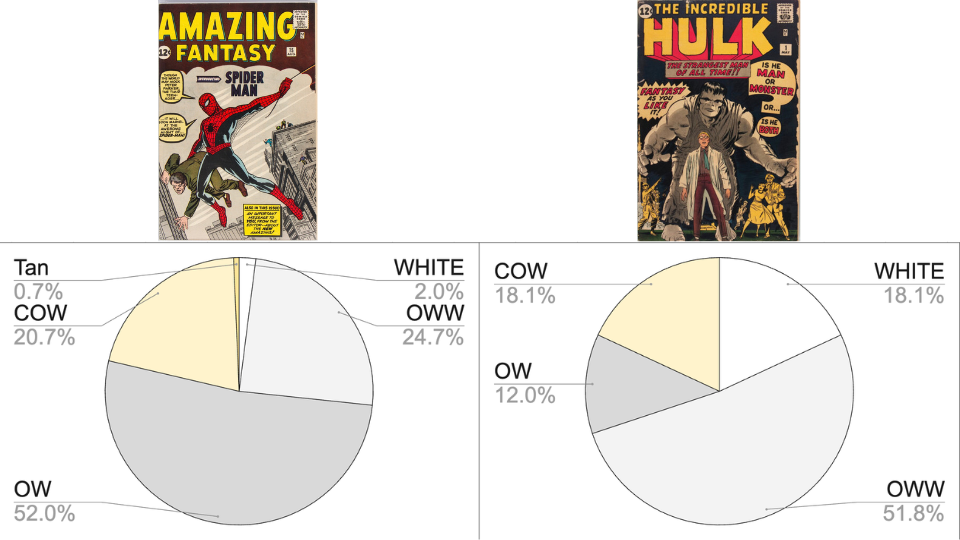
The point being here is that despite being more prevalent overall, it is much tougher to find a White-paged AF #15 than a White-paged Hulk #1.
The DC books overall appeared to have even worse page quality than AF #15. Not only does Brave and the Bold have a low percentage of White-paged books, it has relatively few in Off-White to White or Off-White. In fact, of all the books I examined—including Golden Age—Brave and the Bold #28 had the worst overall page quality.
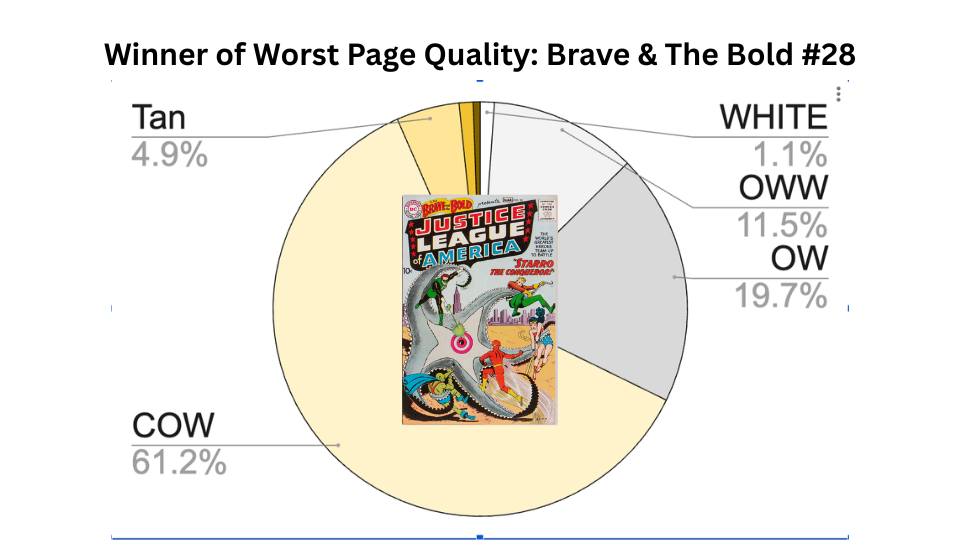
Further, the Silver-Age keys for DC were published earlier in the Silver Age and are considerably less prevalent than the Marvel keys of the same era. Perhaps only 1,000 to 2,000 copies exist overall of each issue.
Given these low numbers, and assuming that only 0.5% to 2% of these books might have White pages, that would imply something like 5 to 40 White-paged copies in existence for each issue.
For these early Silver-Age DC keys, they may be legitimately extremely rare.
Main Takeaway
Generally speaking, I’m more comfortable with people saying that early- to mid-Silver-Age comic books are rare with White pages.
There are certainly exceptions, like the surprisingly fresh-paged Hulk #1, which overall is less common than most Marvel Silver-Age keys but is much more common with respect to nice page quality.
But the general Silver-Age picture is clear: White pages are no longer something you see on a large percentage of graded copies, nor at a high number overall.
Golden-Age Books
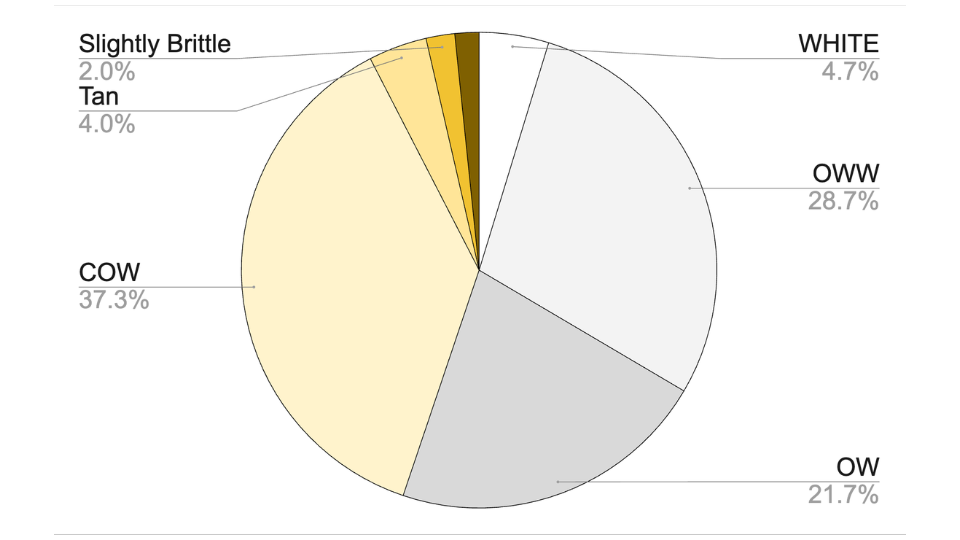
As anticipated, the Golden-Age comic books had the poorest page quality overall.
Surprisingly, however, the page quality wasn’t that much worse than the Silver-Age grails. White pages accounted for just under 5% of the eligible listings, compared to 5.5% for Silver Age.
And the range was tight: 2% (Superman #1) at the low end and 8% (Batman #1) at the high end.
Of note, comics with truly poor page quality—some variant of Tan or worse—were almost at 8%, about triple that of the Silver-Age keys. It is worth mentioning that some golden age publishers like Harry “A” Chesler are notorious for poor page quality and likely would fare worse than the DC and Timely keys and had an even higher percentage with poor quality. Alas, my study is not broad enough to go down these interesting rabbit holes.
Back to the main story. Overall, the page-quality profiles of Golden- and Silver-Age books are more similar than I would have thought. In other words, proportionally, it’s about as difficult to get a White-paged Silver-Age key as a Golden-Age key.
The big difference, however, is the denominator.
That is, many Golden-Age comic books are rare outright. “Rough collector estimates put many Golden-Age keys at between 100 and 500 copies in existence, compared to roughly 1,000 to 15,000 copies for the Silver-Age keys.”
Let's examine Batman #1, which is relatively common for a Golden-Age comic book, with about 300 graded by CGC.
Let’s imagine there are still 200 ungraded, or about 500 copies believed to exist overall.
Assuming that 8% of Batman #1s have White pages, we’re still only looking at 40 copies.
And that's under a fairly generous hypothetical.
That's the most prevalent Golden-Age book I listed, and it also has the best page quality of any Golden-Age book examined!
Think about that for a moment.
A book that is already considered one of the more available Golden-Age keys could potentially have only a few dozen White-paged copies.
Takeaway
Many Golden-Age comic books are rare outright, but if you’re trying to find a Golden-Age book with White pages, it can be nearly impossible.
And that's why I think the phrase “rare White pages” is almost always defensible when talking about Golden-Age books.
So, What Does “Rare White Pages” Actually Mean?
After going through thousands of listings, I think there is a relatively simple way to look at the question.
Age matters, but it shouldn’t be your only consideration.
The percentage of copies with White pages matters. The total number of copies that exist matters. And, ultimately, the combination of those two factors determines how many White-paged copies might actually be out there.
If someone is selling a Copper-Age comic and calling it a “rare White-paged copy,” my default reaction would be disbelief.
If it's a Bronze-Age book, I’d still be skeptical. I’d certainly want some evidence to support the claim.
If it's an early- to mid-Silver-Age book, however, the claim is much more likely to be true.
And if it's a Golden-Age key with White pages?
Well, now we’re talking.
The important takeaway is to consider both the absolute rarity of a particular issue (how many copies exist overall) and the proportion of copies that have White pages.
A comic doesn't become a rare comic simply because it has White pages. But a comic that is semi-scarce like Amazing Fantasy #15 can be considered legitimately rare with White pages when only a tiny percentage maintain pristine page quality.
Closing Thought
Thanks for hanging with me through this page-quality journey.
In the near future, I hope that CGC can add page quality to CGC Census search filters. I would love to examine the top 100 issues per age and include the data from every copy, as opposed to my less thorough, less accurate, and woefully slower sampling through Heritage’s archive.
Perhaps that is a future article!
In the meantime, if you enjoyed reading about “White-paged rarity,” you may be interested in an earlier article I wrote for the Collectors Hub that defines the five main types of rarity for comic books: Comic Book Rarity: Who Cares?
Acknowledgements
Thanks to Ben Labonog for our conversations about rarity and page quality.
Thanks to Heritage Auctions for their open access to picture archives of sold lots. Further, all images of comic books are from HA.com.