Movie hype and comic-book prices have a long, occasionally unhealthy relationship.
A casting announcement drops. A trailer appears. A character who has existed for sixty years suddenly becomes “hot”. By breakfast, somebody is describing a comic with 10,000 graded copies as “rare”.
So, with Avengers: Doomsday approaching cinemas, it is worth separating three things collectors often blend together: what Marvel has actually confirmed, which comics appear to be feeding the movie, and what collectors have genuinely paid for the major books connected to its characters.
And there is plenty to work with.
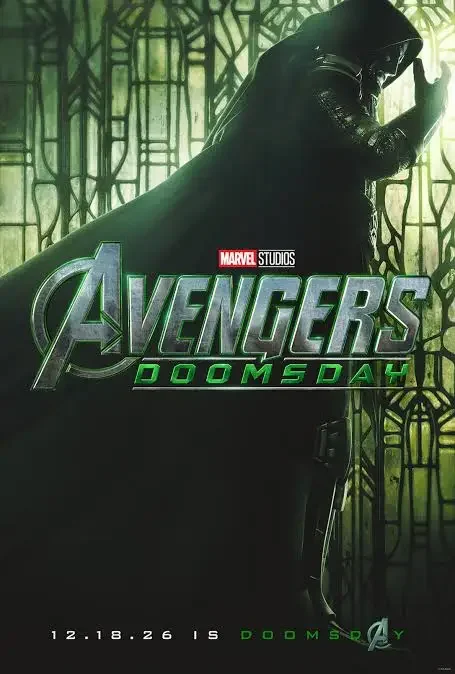
Avengers: Doomsday is currently scheduled for December 18, 2026, with Joe and Anthony Russo directing. It will be followed by Avengers: Secret Wars on December 17, 2027. Marvel has also made something else increasingly clear: this is no ordinary Avengers sequel. The Avengers, Fantastic Four, X-Men and several characters from the group introduced in Thunderbolts are all being pushed onto the same board, with Robert Downey Jr. playing Victor von Doom — Doctor Doom.
Marvel is even sending audiences back to Avengers: Endgame. An Endgame: Encore theatrical rerelease is scheduled for September 25, 2026, and Joe Russo has said its additional material is directly connected to Doomsday. That is probably about as subtle as a Doctor Doom monologue.
Who Is Actually in Avengers: Doomsday?
The cast is enormous.
From the established MCU Avengers side, Chris Hemsworth returns as Thor, Anthony Mackie as Sam Wilson/Captain America, Sebastian Stan as Bucky Barnes, Letitia Wright as Shuri/Black Panther, Paul Rudd as Ant-Man, Simu Liu as Shang-Chi, Danny Ramirez as Joaquin Torres/Falcon, Winston Duke as M’Baku and Tenoch Huerta Mejía as Namor. Tom Hiddleston is also returning as Loki, which becomes particularly interesting when a movie starts dealing with universes colliding.
The Thunderbolts contingent brings Florence Pugh as Yelena Belova, Wyatt Russell as John Walker/U.S. Agent, Lewis Pullman as Bob Reynolds/Sentry, David Harbour as Red Guardian and Hannah John-Kamen as Ghost.
Then comes the Fantastic Four: Pedro Pascal as Reed Richards/Mister Fantastic, Vanessa Kirby as Sue Storm/Invisible Woman, Joseph Quinn as Johnny Storm/Human Torch and Ebon Moss-Bachrach as Ben Grimm/The Thing. Kevin Feige has specifically confirmed that the Fantastic Four continue from their Earth-828 setting into Doomsday, alongside the Avengers and X-Men. He has also described the coming story in terms of the threat of worlds literally colliding.
And then Marvel opened the X-Men cupboard.
Patrick Stewart returns as Professor Charles Xavier, Ian McKellen as Magneto, James Marsden as Cyclops, Kelsey Grammer as Beast, Alan Cumming as Nightcrawler, Rebecca Romijn as Mystique and Channing Tatum as Gambit. Marvel’s subsequent promotion has also confirmed the return of Steve Rogers, played by Chris Evans.
Standing in the middle of all of this is Doctor Doom.
Not Tony Stark. Not, at least according to anything Marvel has publicly confirmed, an evil Iron Man.
Victor von Doom.
That distinction matters for comic collectors because Doom has a very different history, and the comics Marvel appears to be mining place him far above the level of a conventional super-villain.
So, Which Comics Is Avengers: Doomsday Based On?
There is no comic called Avengers: Doomsday that Marvel Studios is simply adapting.
That is the first thing to get out of the way.
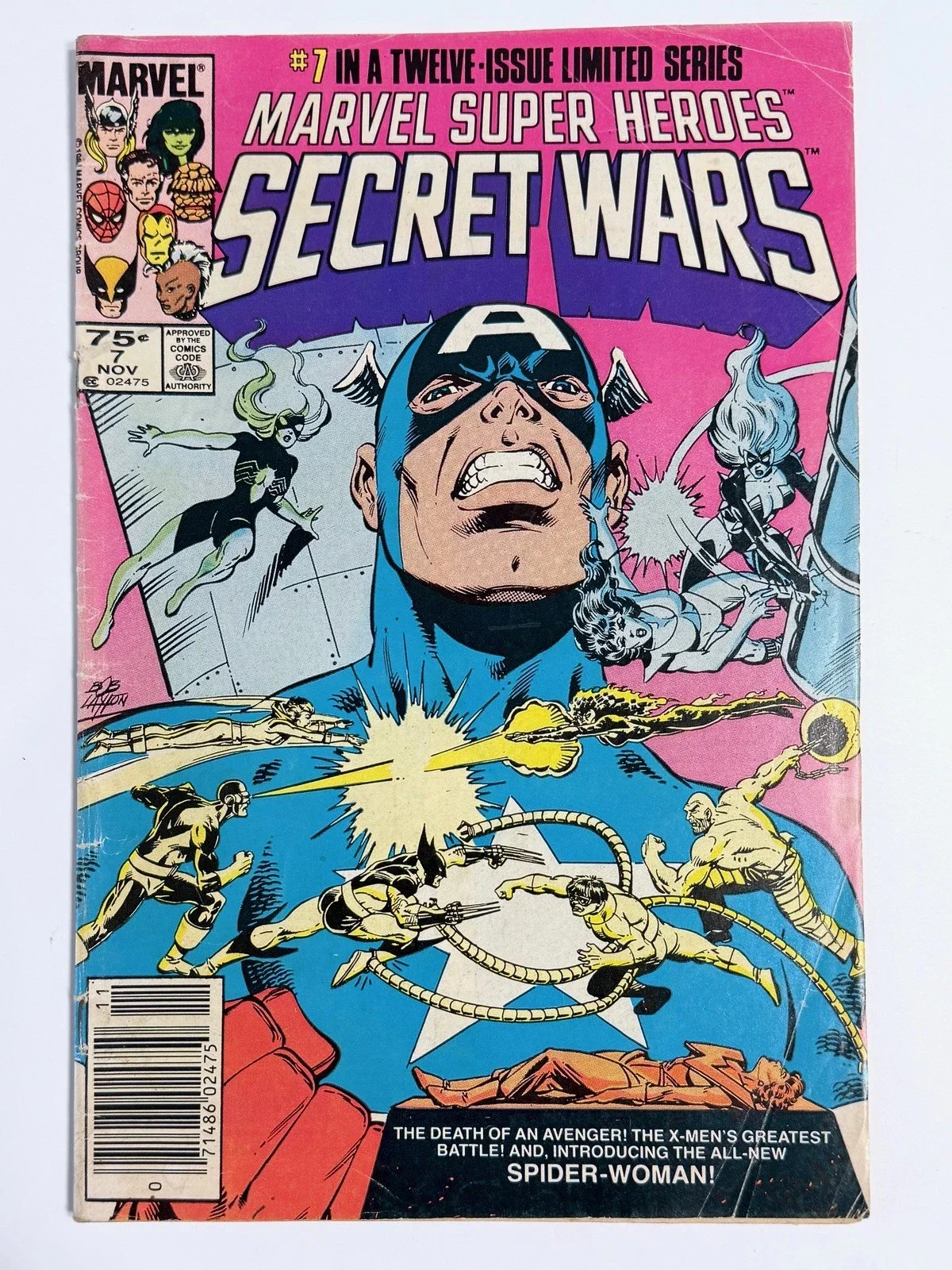
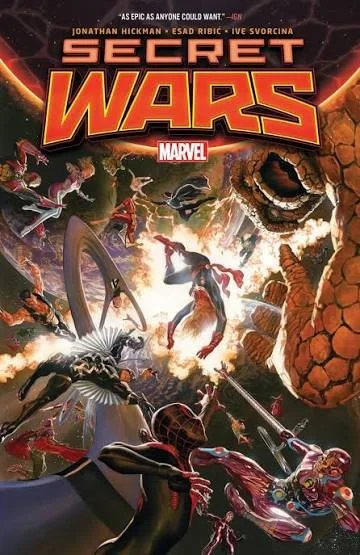
The Russo brothers have repeatedly approached Marvel comics as source material rather than screenplays. They take characters, concepts and major story beats, then construct their own MCU version. The directors have said the two upcoming Avengers films draw inspiration from both the original 1984 Secret Wars and Jonathan Hickman’s 2015 Secret Wars.
That gives collectors a much more useful trail to follow.
Fantastic Four #5 — Where Doctor Doom Begins
Before Battleworld, Incursions and collapsing universes, there is Fantastic Four #5, published in 1962.
This is the first appearance of Doctor Doom, created by Stan Lee and Jack Kirby.
Doom kidnaps the Fantastic Four and sends them back through time in pursuit of Blackbeard’s treasure. On paper, that sounds a long way removed from a multiversal Avengers epic. But the important material is already there: Doom’s intelligence, arrogance, technology and obsession with Reed Richards.
That Reed/Doom rivalry becomes one of the fundamental relationships in Marvel Comics.
For collectors looking for the most important Doctor Doom comic associated with Doomsday, this is the obvious starting point. It does not need a movie to make it significant. The movie simply gives an already major Silver Age key another reason to be discussed.
And that distinction is worth remembering.
Marvel Super Heroes Secret Wars #1-12 — 1984
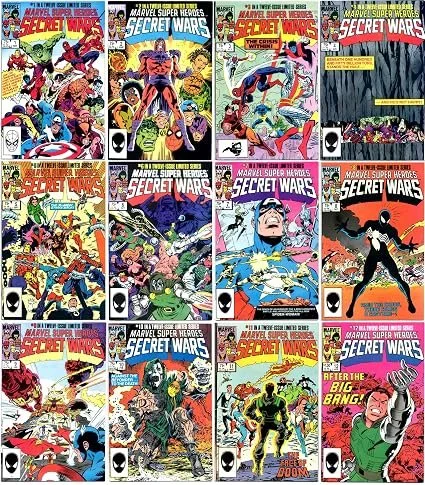
The original Marvel Super Heroes Secret Wars began in 1984, with the first issue published on May 10, 1984.
The Beyonder gathers heroes and villains from Earth and transports them to Battleworld, where the Avengers, X-Men, Fantastic Four, Spider-Man, Hulk and others are thrown together in one enormous crossover.
Sound familiar?
Doctor Doom is one of its central villains, but he does what Doom tends to do whenever somebody more powerful than him appears: he decides that power would look better on Victor von Doom.
Eventually Doom steals the Beyonder’s power and becomes effectively god-like.
The movie does not appear to be adapting this series page-for-page. However, the basic ingredients are difficult to ignore: Avengers, X-Men, Fantastic Four, multiple factions and Doctor Doom seeking power on a scale that dwarfs ordinary superhero conflicts.
For a film called Avengers: Doomsday, it is a fairly convincing family resemblance.
Avengers: Time Runs Out — The Road to the End
Collectors interested in the “worlds colliding” part of Feige’s comments should spend some time with Jonathan Hickman’s Avengers run.
The storyline generally known as Time Runs Out runs through Avengers #35-44 and New Avengers #24-33, beginning in September 2014.
Its central problem is the Incursions.
Entire universes are colliding. If two Earths occupy the same space during an Incursion, both universes can be destroyed. The Avengers and Illuminati are forced into increasingly desperate decisions as the Multiverse begins collapsing around them.
Marvel itself describes Time Runs Out as the road into Secret Wars, culminating in the Final Incursion.
If Doomsday really does involve worlds colliding, this may end up being some of the most useful pre-movie reading available.
Not necessarily because a specific scene will be recreated, but because the problem facing the characters appears remarkably similar.
Secret Wars #1-9 — 2015
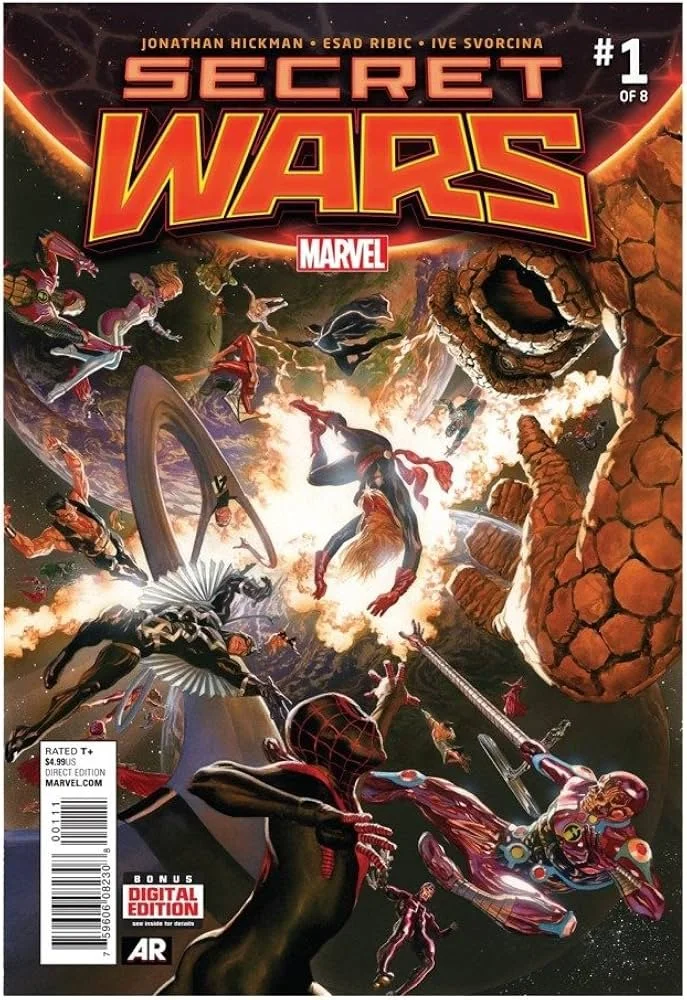
Then we reach the comic that may provide the clearest conceptual bridge to the upcoming movies.
Jonathan Hickman and Esad Ribić’s Secret Wars #1 was published on May 6, 2015.
The Marvel Universe and Ultimate Universe collide during the Final Incursion. The old Multiverse effectively ends, and what remains is assembled into a patchwork reality called Battleworld.
And who rules Battleworld?
Doctor Doom.
Not merely Doctor Doom with better armour.
God Emperor Doom.
The surviving pieces of different realities exist under Doom’s rule, with heroes and villains from multiple universes forced into the same world.
Put that beside Marvel Studios talking about the Fantastic Four arriving from another universe, X-Men returning from another continuity and an existential threat involving worlds colliding, and the connection becomes difficult to miss.
That does not mean Robert Downey Jr. will inevitably appear in white robes as God Emperor Doom.
But if you want to understand why Marvel chose Doctor Doom for these particular Avengers movies, Hickman’s Secret Wars provides a pretty persuasive answer.
The Team Keys: Avengers #1, Fantastic Four #1 and X-Men #1
There is another category of books likely to receive attention as the movie approaches: the original team keys.
Fantastic Four #1 from 1961 introduces the Fantastic Four.
X-Men #1 from 1963 introduces Professor X’s original X-Men and Magneto.
Avengers #1 from 1963 brings together Thor, Iron Man, Hulk, Ant-Man and Wasp as the Avengers.
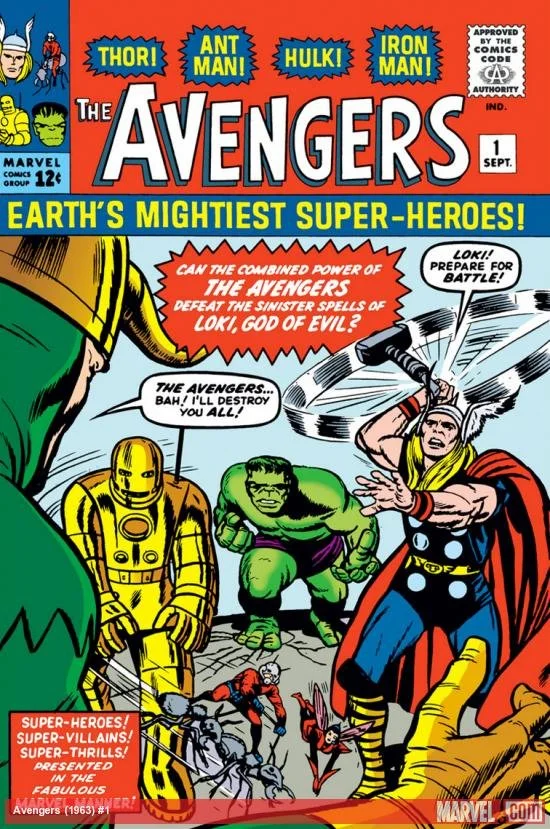
None of these comics should be described as a direct source for the plot of Doomsday. They matter for a simpler reason. Marvel is placing three of its historically important teams into one movie, and collectors have always placed a premium on earliest appearances.
They were major keys before Kevin Feige had a cinematic universe. They will remain major keys long after Doomsday leaves theatres.
That is generally the sort of movie-related book I prefer.
What Have Collectors Actually Paid?
A word of caution before throwing around the phrase “record sale.”
A publicly recorded sale is not the same thing as knowing every transaction that has ever occurred. Private sales disappear from view, a single CGC-certified comic can be bought and sold several times, and sales databases inevitably capture only part of the overall market. That distinction between the CGC Census, individual slabs and recorded sales is important whenever we start making claims about the “highest price ever paid”.
The figures below are therefore publicly documented auction or marketplace records/highs that can be verified, and all prices are in US dollars.
| Comic | Why it matters to Doomsday | Publicly documented high | Date / venue |
|---|---|---|---|
| Fantastic Four #1 (1961), CGC 9.6 | First Fantastic Four | $2,040,000 | Heritage, September 15, 2024 |
| X-Men #1 (1963), CGC 9.6 | First X-Men; Professor X and Magneto | $871,999.20 | ComicConnect, September 23, 2022 |
| Avengers #1 (1963), CGC 9.6 | First Avengers team | $432,000 | Heritage, April 7, 2024 |
| Fantastic Four #5 (1962), CGC 9.4 | First Doctor Doom | $210,000 | ComicLink, August 2022 |
| Marvel Super Heroes Secret Wars #1 (1984), CGC 9.8 | Beginning of original Secret Wars | $960 tracked high for a standard CGC 9.8 | Heritage, July 19, 2021 |
| Marvel Super Heroes Secret Wars #10 (1985), CGC 9.8 | Major Doom/Beyonder issue | $450 tracked high | eBay, August 10, 2024 |
The numbers tell an interesting story.
The books most directly connected to the Secret Wars story can still be bought for a tiny fraction of what collectors pay for the great Silver Age first appearances.
That makes sense. Historical importance, supply, demand and age all matter.
A comic does not become expensive simply because it inspired a billion-dollar movie.
Did the Doomsday Announcement Cause These Records?
Mostly, no.
And this is where the dates become particularly useful.
The $210,000 Fantastic Four #5 record occurred in August 2022.
The $871,999.20 X-Men #1 sale occurred in September 2022.
The $432,000 Avengers #1 record occurred on April 7, 2024.
Robert Downey Jr. was not unveiled as Doctor Doom until Marvel’s San Diego Comic-Con presentation in July 2024.
In other words, three of the most obvious Doomsday-associated record sales happened before collectors even knew Avengers: Doomsday existed in its current form.
That is important.
It would be very easy to place those sale prices beside an Avengers movie poster and imply that movie speculation created them. The chronology tells us otherwise.
Fantastic Four #1 provides a slightly different example. Its extraordinary $2.04 million CGC 9.6 sale came in September 2024, after Downey had been announced as Doctor Doom. But even there, correlation is not causation. It was one of the finest graded copies of one of the most important Silver Age comics ever published. A multimillion-dollar result did not require Robert Downey Jr. to make the book important.
Perhaps the most interesting market example is Fantastic Four #5 itself.
Despite all the excitement surrounding Doctor Doom, its $210,000 CGC 9.4 record from 2022 has not simply been blown away by movie speculation. Heritage recorded a CGC 9.4 at $130,000 on May 28, 2024, and another at $120,000 on September 11, 2025.
Think about that for a moment.
Doctor Doom became the announced villain of one of the biggest upcoming Marvel films. Robert Downey Jr. was cast. The Fantastic Four joined the MCU.
And a top-grade Fantastic Four #5 still did not automatically exceed its old record.
Movie heat can increase attention.
It cannot force two bidders to keep raising their hands.
What Should Collectors Watch?
The obvious books are obvious for a reason.
Fantastic Four #5 is Doctor Doom’s first appearance. Secret Wars from 1984 establishes the giant Marvel crossover and Doom’s theft of cosmic power. Time Runs Out provides the collapsing-worlds mechanics. Hickman’s 2015 Secret Wars gives us Incursions, Battleworld and a Doctor Doom who has achieved something close to absolute power.
Those books tell a coherent story even if you never watch the movie.
That is what I like about them.
The more speculative end of the market will inevitably begin searching for obscure Doom appearances, alternate-universe variants and panels containing concepts that may or may not show up for seven seconds in a trailer.
Some of those bets will work.
Many will not.
We have seen this movie before — figuratively and literally.
The Collector Hub principle remains useful here: understand what you are buying. A comic with genuine historical significance does not suddenly lose that significance if Marvel changes a screenplay. A comic purchased only because somebody on social media promised it was the “next big Doomsday key” has a rather less comfortable safety net.
Final Thoughts
Avengers: Doomsday may turn out to be the most comic-book-like Avengers movie Marvel has attempted.
The Avengers are there.
The Fantastic Four are there.
The X-Men are there.
Multiple universes are colliding.
And Doctor Doom is standing in the middle of it.
For comic readers, the path from Fantastic Four #5, through Secret Wars (1984), into Time Runs Out and Secret Wars (2015) is a fascinating one. For collectors, it provides something even better: a way to distinguish comics that genuinely matter to Marvel history from books that merely happen to be enjoying a moment of speculation.
By December 18, 2026, we will know how much of that comic history the Russo brothers actually used.
Until then, enjoy the speculation.
Just don't pay God Emperor Doom prices for a mortal comic.