The Top 10 Rarest Mega-Grails
In a previous Collector Hub article, I focused on the rarest, most expensive books in the hobby, but some people complained that the books were too obscure. So this time, I’m taking a look at the 10 rarest mega-grails from the Golden Age. Specifically, I’ve picked from the Top 30 Golden Age comics according to the Overstreet Price Guide #54. These are exceptionally expensive comics, and many of them are well known—even to casual collectors. These books will break the bank, if you’re lucky enough to find a copy.
Preamble
Before we get to the rarest mega-grails, let’s set the table regarding rarity. The most published comic book in history is X-Men #1 (1991). Eight million copies were printed, and likely millions survive today. Regarding comics certified by CGC, Amazing Spider-Man #300—the first appearance of Venom—currently holds the record at 39,914 copies. Hulk #181, a popular comic from the Bronze Age, has 19,568 certified copies. As for the Silver Age, a popular Marvel key like Fantastic Four #1 has 3,244 certified.
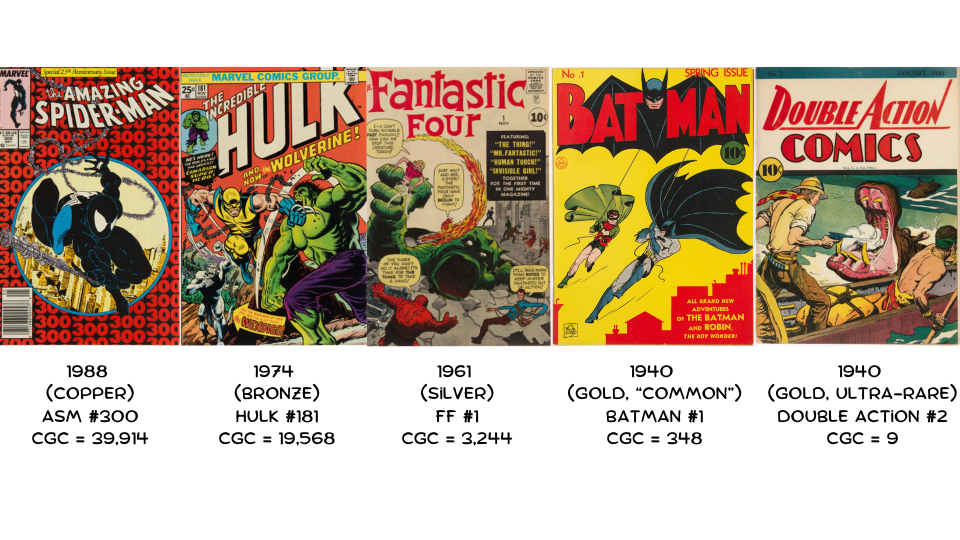
As we move to the Golden Age, we are no longer talking about tens of thousands—or even thousands—of copies slabbed by CGC. In fact, few Golden Age books have more than 250 copies graded. For example, one of the most “common” Golden Age comics, Batman #1 (1940), has merely 348 certified copies. Batman #1 is certainly a mega-key, but it’s too prevalent to make this list.
On the other end of the continuum, ultra-rare valuable comics tend to have between six and a dozen copies. For example, Double Action Comics #2 has just nine copies on the census. That said, these books don’t quite qualify as mega-grails, although they can still fetch tens of thousands of dollars in mid-grade.
One caveat before we begin: All CGC census figures cited are current as of this writing and are used as a comparative tool rather than an absolute measure of rarity.
The List
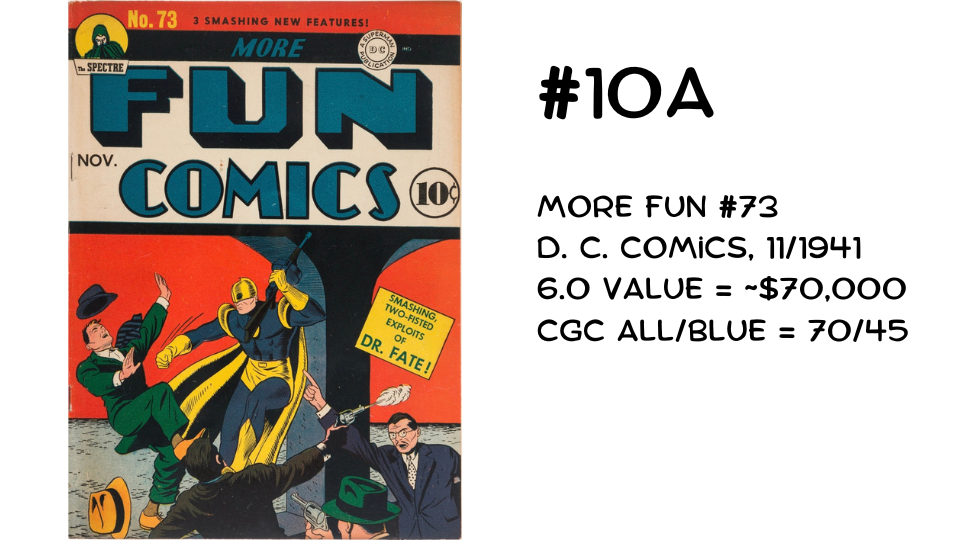
Without further ado, the 10 Rarest Mega-Grails list starts at 70 copies certified by CGC. We have a tie at the entry spot—and this one is chock-full of star power. Hidden inside the pages of More Fun Comics #73 are the first appearances of Aquaman and Green Arrow. Speedy also debuts here.
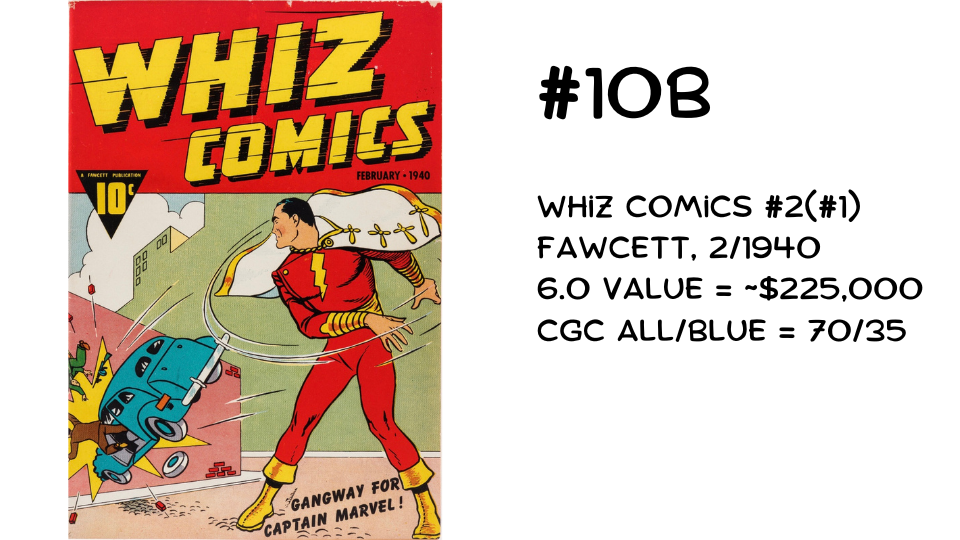
The cover of Whiz Comics #2 isn’t so bashful. Fawcett’s Captain Marvel—affectionately known as the Big Cheese—made his ostentatious first appearance here. Golden Age aficionados know that Captain Marvel was the most popular superhero of the 1940s, bar none, despite his second-class treatment today.
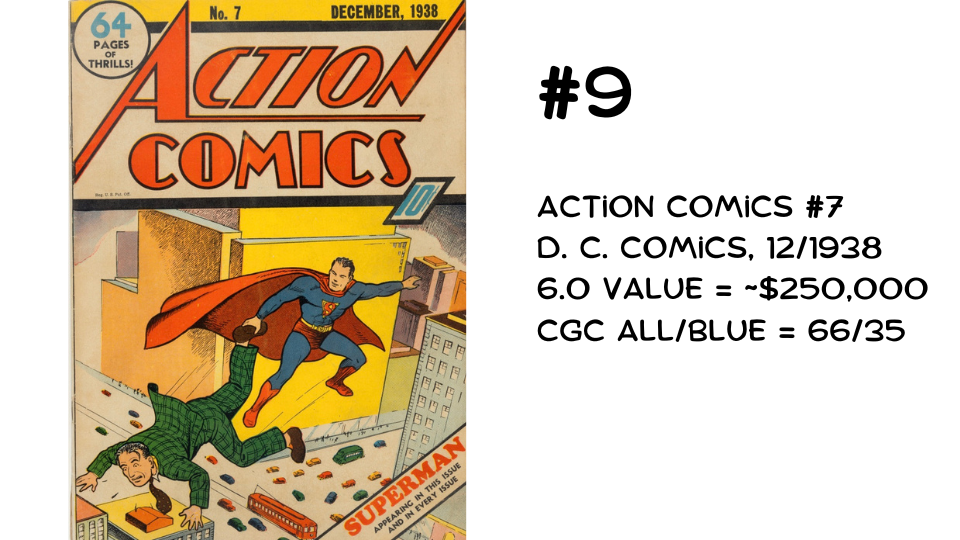
Action Comics #7 holds the ninth-rarest spot by itself. This comic represents the second time Superman appears on the cover of any issue. Additionally, it’s the first time the word “Superman” appears on a cover. Despite Superman appearing to be airborne, this is actually due to his jumping ability. Apparently, the writers didn’t gift him true flight until much later.
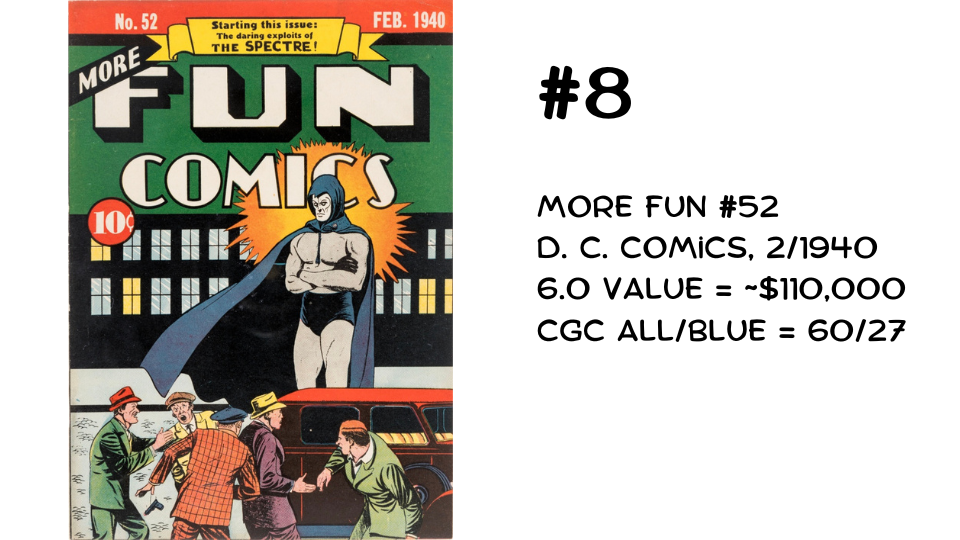
Eighth on our list is More Fun Comics #52, which features the debut of DC’s mysterious character, the Spectre. Notice that his cowl is blue. In the next issue and thereafter, it’s green—an interesting early color change that’s less well known than the gray-to-green shift seen from Hulk #1 to Hulk #2.
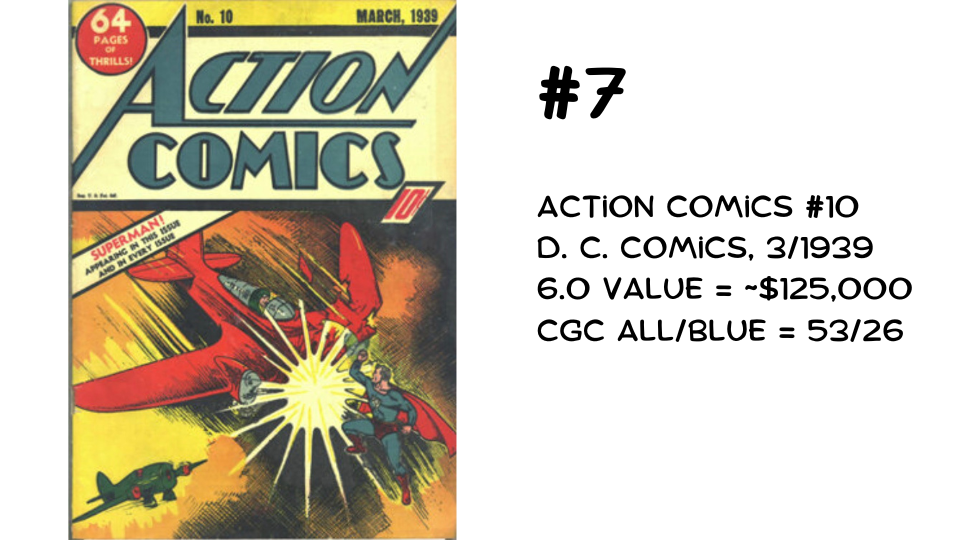
I know what you’re thinking—oh, now is when we see Superman fly. Nope. Action Comics #10 features a leaping Superman punching a plane on this dynamic cover, which is his third appearance on a cover. Scanning research on the topic, the exact moment Superman first flew is debatable, with some of the earliest references appearing in cartoons before the comics. Action Comics #65 and #125 are often cited as possible candidates for flight in comics.
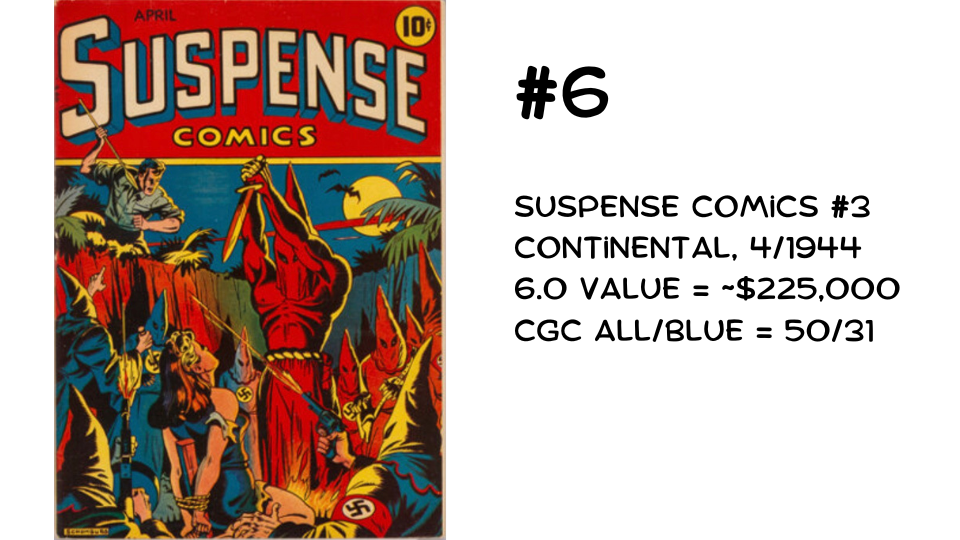
At #6, we have the biggest oddity on this list. There’s no tie-in with a superhero, no first issue, and no major historical milestone. So how does Suspense Comics #3 make the cut? Simple: it features a masterpiece of a cover drawn by the era’s greatest cover artist, Alex Schomburg.
Even so, this was an obscure book until Ernie Gerber featured it prominently in his 1989 Photo-Journal. Since then, it’s grown in status into one of the most desired comic books among well-heeled collectors.
Even tougher is finding this issue in nice shape. Of the 31 Universal copies graded, an astounding 17 are graded 1.5 or lower.
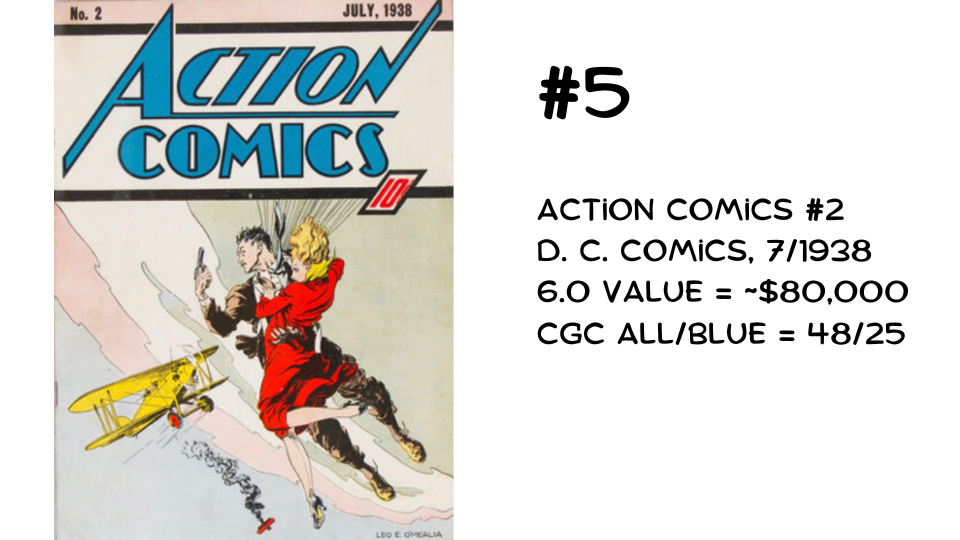
Speaking of beautiful covers, Action Comics #2 doesn’t get the respect it deserves, in my opinion. Leo O’Mealia serves up one of the best images of 1938, with the protagonist parachuting from his disabled aircraft—damsel in one hand and a pistol in the other. The problem: the protagonist isn’t Supes.
While Action #2 is the second appearance of Superman, the fact that he isn’t on the cover suppresses its value. Though still costly, it sells for a fraction of Action Comics #7.
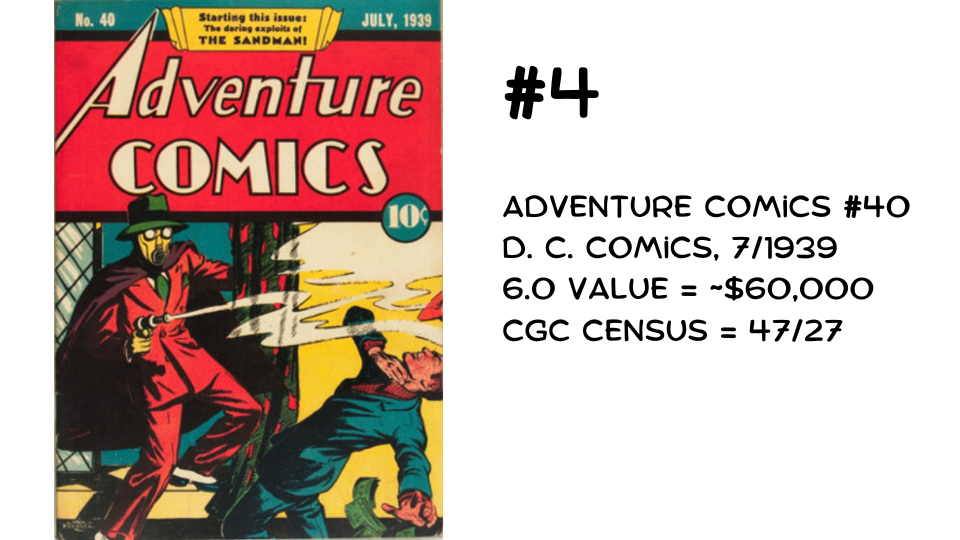
While the Sandman first appears in New York’s World Fair #NN, Adventure Comics #40 is credited as his first conceived story and his first full cover appearance. Like the Spectre, the Sandman is a darker character than many early superheroes. The contrast of the bespoke suit and the gas mask somehow speaks to my heart.
Another link to the Spectre: both characters are founding members of the Justice Society of America, the first superhero team, which debuted in All-Star Comics #3.
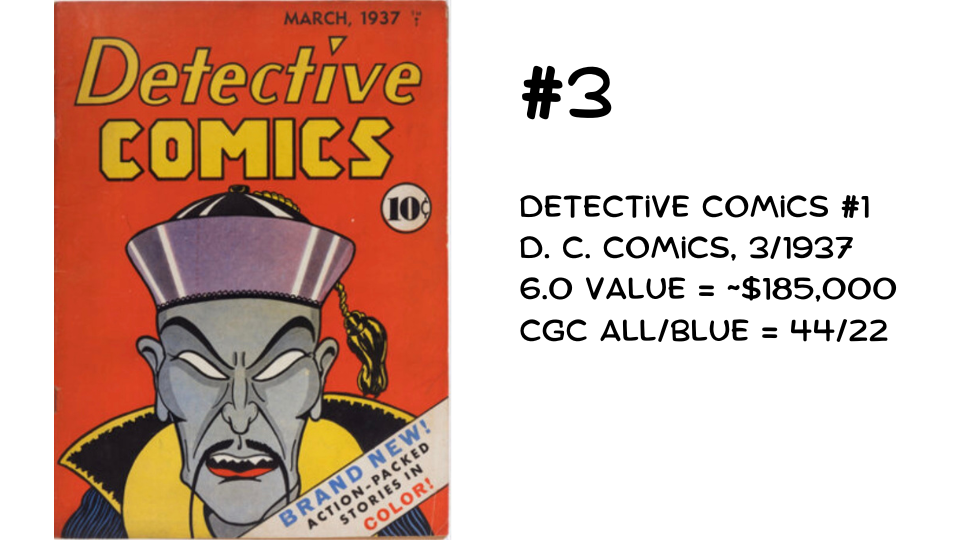
Now we’re getting into notoriously difficult books to find. Detective Comics #1 is the earliest-published book on this list (March 1937). Overstreet classifies it as Golden Age, though some collectors consider it Platinum Age because it predates Action Comics #1 by over a year.
Regardless, this is a highly coveted book, especially among old-time collectors. It’s the first issue of the title that would eventually give birth to Batman, and its abbreviated title would later become the name of the publisher: DC.
Regarding rarity, not only was this book known to be tough, it was considered impossible in high grade. In fact, Overstreet didn’t even list a price for NM- (only VF), believing no copy approached that level. So far, he’s been right. Of the mere 44 Detective Comics #1 copies on census, only 22 are Universal (blue-label) copies. The three highest-graded Universal copies are a 7.0, an 8.0, and an 8.5.
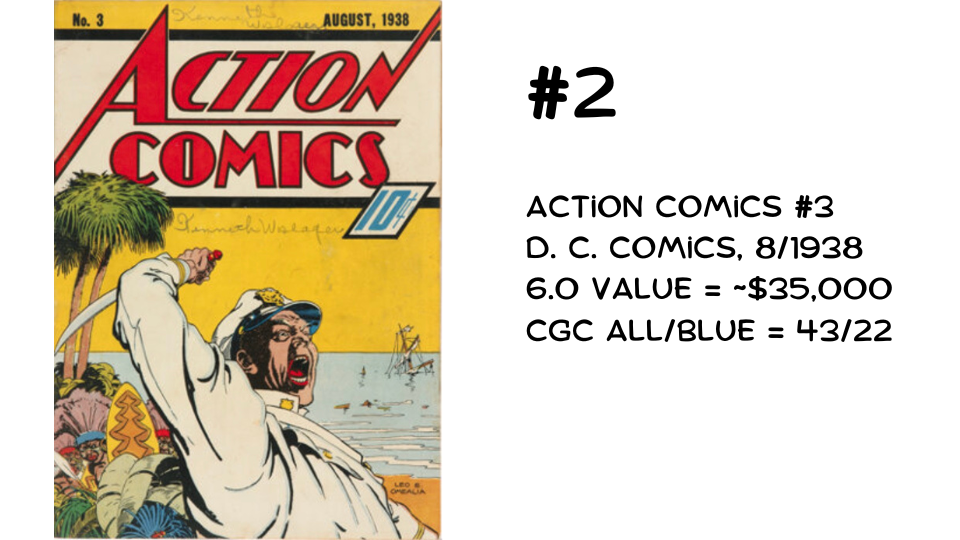
The silver medal of mega-grail rarity goes to Action Comics #3, with only 43 copies on census. Siegel and Schuster collaborate again to bring us the third appearance of Superman. Once more, O’Mealia delivers a non-Superman cover.
Many readers may wonder where Action Comics #1 falls in terms of CGC count. It currently sits at 86—about double that of Action Comics #2 and #3. According to interviews I’ve had with legendary collector and historian Gary Clark, the second and third issues of Golden Age comics are often scarcer than the first. Publishers typically printed and circulated more copies of issue #1, then reduced print runs for #2 and #3. It was often around issue #4 that sales data from the first issue would determine whether a series continued.
This may help explain why Action Comics #2 and #3—and Detective Comics #2 and #3 (not valuable enough to make this list)—are more difficult to find than their respective first issues.
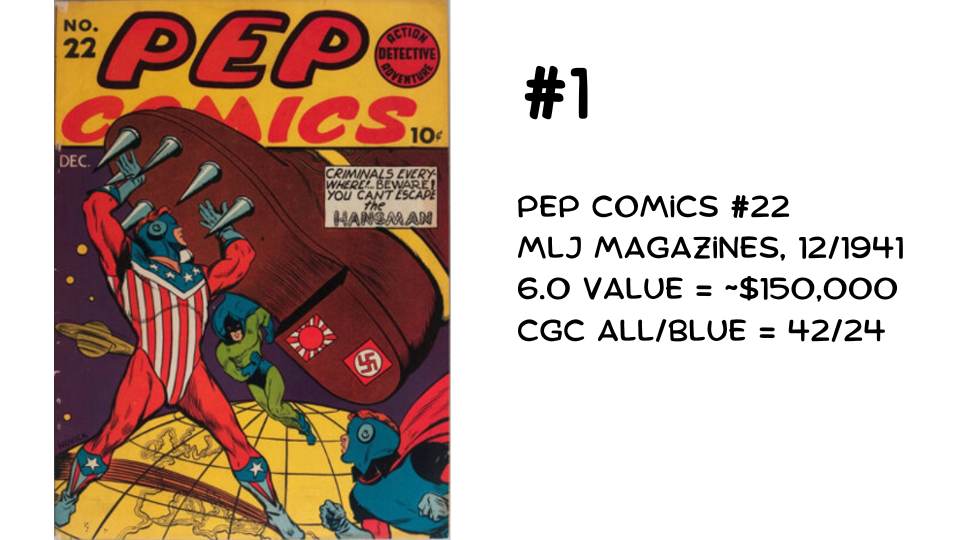
At the top of the list is Pep Comics #22, with a mere 42 copies on the CGC census. Like More Fun Comics #73 at the tail end of our list, the significance of this book is hidden within its pages. It features the first appearance of Archie Andrews, America’s favorite teenager.
What I love about this book is the contrast between Archie—a lighthearted teenage character—and the much more serious wartime cover. MLJ’s patriotic hero, the Shield, holds off a spiked Nazi-Japanese boot from trampling the globe.
Conclusion
Many comics are in high demand but relatively prevalent. Others are genuinely rare, yet few collectors care about them. This list of mega-grails highlights the sweet spot where extreme rarity meets sustained demand.
For those interested in how these comics compare across the broader landscape, I’ve included CGC census counts for all of the Top 30 Golden Age mega-grails below, along with notes on methodology and links to other Collector Hub articles and YouTube videos I’ve authored on the subject of rarity. Whether you’re a seasoned Golden Age collector or simply fascinated by the upper limits of the hobby, these books represent the ceiling—where history, art, and scarcity collide.
Owning one isn’t just about possession. It’s about stewardship of the rarest survivors from the dawn of comic books.
The Top 30 Golden Age Comics by CGC Census Count
| Rarity Rank | Title & Issue | CGC Census | Universal Only |
|---|---|---|---|
| 1 | Pep 22 | 42 | 24 |
| 2 | Action 3 | 43 | 22 |
| 3 | Detective 1 | 44 | 22 |
| 4 | Adventure 40 | 47 | 27 |
| 5 | Action 2 | 48 | 25 |
| 6 | Suspense 3 | 50 | 31 |
| 7 | Action 10 | 53 | 26 |
| 8 | More Fun 52 | 60 | 27 |
| 9 | Action 7 | 66 | 35 |
| 10 | Whiz 2 (1) | 70 | 35 |
| 10 | More Fun 73 | 70 | 45 |
| 12 | All-American 16 | 73 | 37 |
| 13 | Marvel 1 | 76 | 42 |
| 14 | Action 13 | 77 | 45 |
| 15 | Archie 1 | 78 | 61 |
| 16 | Action 1 | 86 | 45 |
| 17 | Detective 27 | 87 | 41 |
| 18 | Detective 29 | 89 | 48 |
| 19 | Flash 1 | 99 | 56 |
| 20 | Detective 35 | 108 | 63 |
| 21 | Detective Comics 31 | 118 | 73 |
| 21 | Detective 33 | 118 | 71 |
| 23 | Sensation Comics 1 | 123 | 84 |
| 24 | Sub-mariner 1 | 158 | 91 |
| 25 | Detective 38 | 169 | 94 |
| 26 | Superman 1 | 212 | 95 |
| 26 | Captain America 1 | 212 | 103 |
| 28 | Wonder Woman 1 | 217 | 143 |
| 29 | All-Star 8 | 229 | 168 |
| 30 | Batman 1 | 348 | 174 |