From the first illustrated stories to the birth of an industry that changed popular culture forever.
Have you ever wondered who bought the very first comic book?
Not the first copy of Action Comics #1 in 1938, or the first appearance of Batman in Detective Comics #27 in 1939. I'm talking about the very first comic book that someone actually paid money for.
Who created it? Who published it? Where was it sold? And perhaps most interestingly, who was standing on the other side of the counter, handing over their hard-earned money for something that would eventually become one of the most recognisable forms of popular entertainment in the world?
Today, comic books are collected, graded, preserved and traded for extraordinary amounts of money. A single Golden Age comic can command millions of dollars. Yet the earliest publishers weren't thinking about CGC grades, census populations or investment returns.
They were simply trying to find an audience willing to pay for illustrated stories.
To understand how we got here, we need to travel back almost two centuries, well before Superman, Batman or even the modern American comic book existed.
1825: The First Comic Book Wasn't American
When we think about the origins of comics, most of us immediately think of the United States. After all, America gave us Superman, Batman, Spider-Man and the publishing empires of Marvel and DC.
But the story begins somewhere rather unexpected.
Glasgow, Scotland.
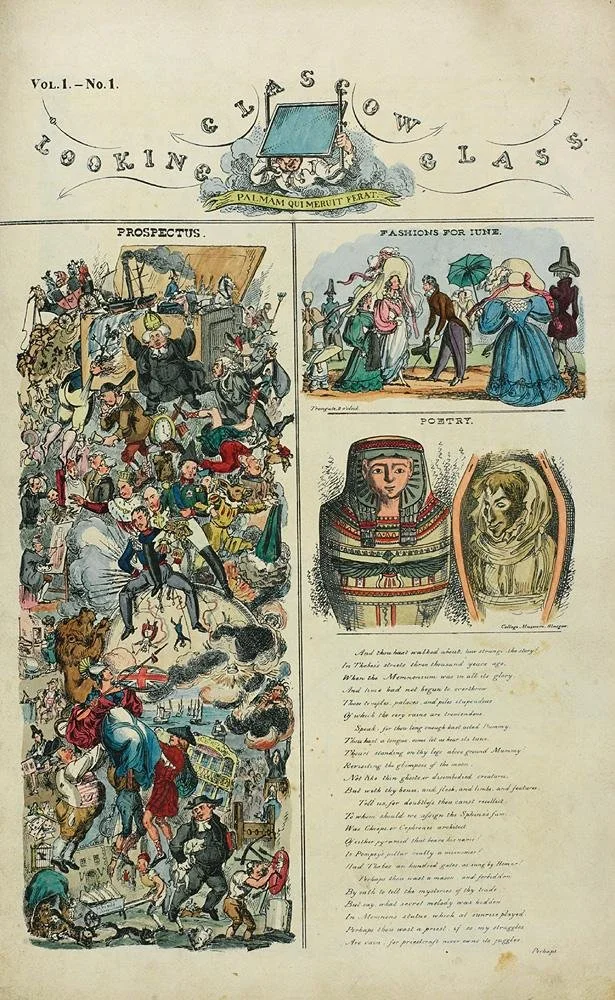
On 11 June 1825, a publication called The Glasgow Looking Glass appeared, featuring illustrated satire, political commentary, humour and sequential picture stories.
Created by caricaturist William Heath, the publication was produced by printer John Watson, with financial backing from Thomas Hopkirk.
It was published by John Watson & Company using lithographic printing, a relatively innovative technique for the period.
The publication made fun of politicians, fashionable society and everyday life. It contained picture sequences that told stories, sometimes across multiple panels, incorporating many of the visual storytelling techniques we associate with modern comics.
The publication subsequently changed its name to The Northern Looking Glass and continued until 1826.
Was this the world's first comic book?
That depends on how we define a comic book.
It wasn't a stapled, ten-cent magazine sitting on a newsstand. It was closer to an illustrated satirical periodical. However, historians have made a compelling case that it represents one of the earliest examples of the modern comics medium.
And that's an important distinction.
The comic book didn't suddenly appear in the 1930s. It evolved from an established tradition of using pictures to tell stories, entertain readers and comment on society.
1837–1842: The First American Comic Book?
Our next stop is Switzerland.
A teacher, artist and author named Rodolphe Töpffer had been experimenting with illustrated narratives that combined sequences of drawings with written captions.
One of his best-known works, Histoire de M. Vieux Bois, was created in the 1820s and first published in 1837.
Rather than using one large illustration to accompany a written story, Töpffer arranged drawings sequentially, allowing the pictures themselves to carry the narrative.
Sound familiar?
In 1842, the story reached American readers under the title The Adventures of Obadiah Oldbuck.
It appeared as an English-language publication associated with the New York newspaper Brother Jonathan, published by Wilson & Company.
The American version is widely recognised as one of the earliest comic books published in the United States.
The format was very different from what collectors recognise today. It used black-and-white illustrations with descriptive captions underneath rather than the dialogue balloons and colourful layouts that would become commonplace.
Nevertheless, the fundamental concept was there.
An illustrated story, told through a sequence of pictures, published for readers to enjoy.
There is something fascinating about the fact that an early landmark in American comics was actually the work of a Swiss artist.
The American comic book industry was still nearly a century away.
1890s–1920s: The Newspaper Creates an Audience
By the late 19th century, newspapers had become a powerful form of mass communication.
Publishers were competing aggressively for readers, and illustrated humour proved to be an excellent way to attract attention.
One of the most influential examples was The Yellow Kid, created by Richard F. Outcault, which became a sensation during the 1890s.
Newspaper publishers Joseph Pulitzer and William Randolph Hearst recognised the commercial appeal of comic strips.
Popular strips could attract readers, boost newspaper circulation and encourage families to purchase particular newspapers.
Characters such as The Katzenjammer Kids, Buster Brown, Mutt and Jeff and Little Nemo in Slumberland became familiar to American audiences.
And here's where things become interesting from a business perspective.
The publishers already possessed something that modern entertainment companies spend enormous sums trying to develop.
Recognisable characters with established audiences.
Newspaper strips were subsequently collected and republished in booklets and books, allowing readers to enjoy favourite stories outside their original newspaper appearances.
The idea that people would pay specifically for comic-strip entertainment had already been established.
The challenge was finding the right format, price and distribution model to turn that interest into a sustainable standalone publishing business.
1929: The First Ten-Cent Newsstand Comic?
Now we're getting closer to the comic book we recognise today.
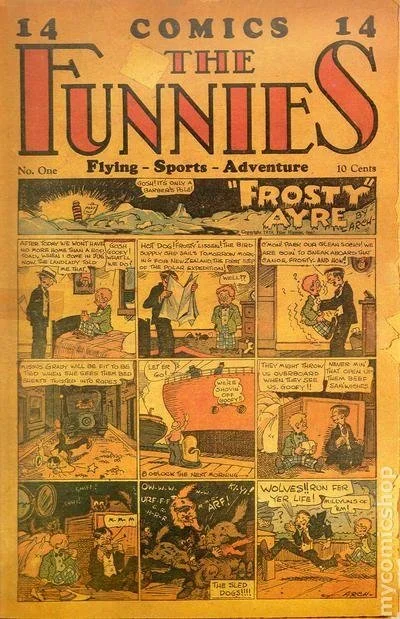
In January 1929, George T. Delacorte Jr., founder of Dell Publishing, was involved in launching a publication called The Funnies.
Unlike many earlier publications, The Funnies featured original comic-strip material rather than relying entirely on newspaper reprints.
The first issue was dated 16 January 1929, with an indexed on-sale date of 9 January.
It contained 24 pages, measured approximately 10.5 by 15.5 inches and carried a cover price of 10 cents.
The publication was edited by Harry Steeger, with contributors including Joe Archibald, who created the cover feature Frosty Ayre.
The first two issues carried the publishing imprint Film Humor Inc., with Dell Publishing becoming the principal publisher as the series continued.
What makes The Funnies particularly significant is that it was sold independently on newsstands.
In other words, a customer could walk up to a newsstand, hand over ten cents and purchase an illustrated collection of comic stories.
This was happening nine years before Superman's first appearance.
Unfortunately, commercial success proved elusive.
The Funnies ran for 36 issues between 1929 and 1930. Its price and publication schedule changed during the run, but the experiment ultimately failed to establish a profitable long-term market.
From a collector's perspective, however, the significance of the publication shouldn't be underestimated.
If we're asking which early American comic publication was demonstrably offered for sale to individual consumers, The Funnies #1 deserves serious consideration.
It just wasn't the comic book that transformed the industry.
That would come a few years later.
1933: The Printing Company That Changed Everything
The next important development came from an unlikely source.
A printing company.

The Eastern Color Printing Company, based in Waterbury, Connecticut, had been involved in producing colour newspaper comic sections.
Two employees, Harry L. Wildenberg and Maxwell Charles Gaines, recognised that newspaper comic strips might have commercial value outside the newspapers themselves.
Their idea was relatively straightforward.
Take existing newspaper comics, reproduce them in a smaller, inexpensive magazine format and distribute the resulting publication as a promotional product.
In 1933, Eastern Color produced Funnies on Parade.
The 32-page publication reprinted popular newspaper comic strips and was distributed as an advertising premium through Procter & Gamble.
It wasn't originally intended to be sold at newsstands.
Instead, the comic was designed to encourage consumers to purchase other products.
Think about that for a moment.
One of the most important developments in comic book history wasn't initially about selling comic books.
It was about using comics to sell something else.
The success of these promotional publications demonstrated that readers enjoyed having familiar comic strips collected into a convenient, portable format.
And Max Gaines began considering an obvious question.
If people liked receiving these comics for free, would they be prepared to pay for them?
1933–1934: The First Commercial Breakthrough
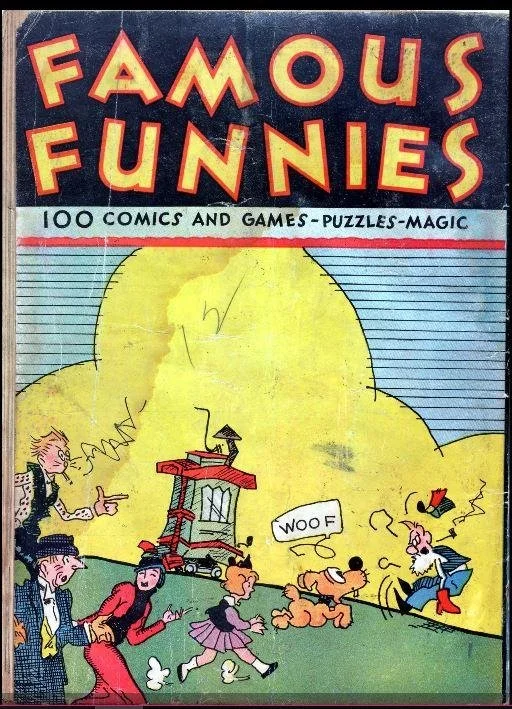
Later in 1933, Eastern Color collaborated with Dell Publishing on Famous Funnies: A Carnival of Comics.
The publication helped establish the size, layout and general appearance of the modern American comic book.
Accounts of its distribution differ. It has traditionally been associated with Woolworth's department stores, although historians have questioned whether all copies were sold or some were distributed without charge.
There is also a frequently repeated story involving Max Gaines.
According to accounts of the period, Gaines placed ten-cent stickers on a small number of leftover comic books and arranged for them to be sold through local newsstands.
When he returned, the copies had reportedly sold.
Whether every detail of this experiment can be independently verified is another matter, but the story captures a pivotal change in thinking.
The comic book was no longer simply an advertising premium.
It could become a product in its own right.
In February 1934, an early retail edition of Famous Funnies was distributed through department stores, with approximately 35,000 copies reportedly selling out.
Then came the real breakthrough.
In May 1934, Eastern Color Printing published Famous Funnies #1, beginning a regular series sold through newsstands.
The cover advertised a collection of comics, games, puzzles and magic for just ten cents.
Initially, commercial results were disappointing. The early issues lost money, and the publishers faced scepticism from distributors and advertisers who questioned whether consumers would pay for material they might already have seen in newspapers.
But the business improved.
By the later issues of its first year, Famous Funnies had become profitable, helping establish the commercial foundations of the American comic book industry.
It wasn't the first illustrated narrative.
It wasn't the first American comic.
And it wasn't even the first comic publication to carry a ten-cent newsstand price.
What it did demonstrate was that the modern comic book could support an ongoing, commercially viable publishing business.
That's why Famous Funnies #1 occupies such an important position in comic book history.
What Was the First Recorded Comic Book Sale?
For collectors accustomed to examining recorded sales histories, this is perhaps the most intriguing question of all.
Unfortunately, we can't identify the first individual ever to purchase a comic book.
There is no surviving, universally recognised transaction record showing the name of the earliest buyer, the exact copy purchased and the amount handed over.
The historical record allows us to identify publications offered for sale, advertised cover prices and later circulation figures.
It generally doesn't allow us to reconstruct the very first customer transaction.
There are, however, several useful milestones.
1842 — The Adventures of Obadiah Oldbuck: An important early American comics publication, although no verified first customer transaction has been established.
1929 — The Funnies #1: An early standalone newsstand comics publication with a documented cover price of ten cents and an indexed on-sale date in January.
1934 — Famous Funnies, Series 1: An early comic book retail experiment, with a reported initial distribution of approximately 35,000 copies.
1934 — Famous Funnies #1: The beginning of the regular newsstand series that helped establish a sustainable commercial comic book market.
These milestones should not be confused with a documented first sale.
A publisher printing 35,000 copies doesn't establish that 35,000 were sold. Equally, a ten-cent cover price doesn't tell us who made the first purchase.
For an industry that now places enormous importance on accurately recorded transactions, it's rather ironic that its earliest sales are largely lost to history.
1935: The Beginning of Original Comic Book Stories
Early American comic books relied heavily on reprinting newspaper strips.
That made commercial sense.
Newspaper characters were already familiar, and publishers could license material that had previously appeared elsewhere.
But an industry built entirely on reprints had obvious limitations.
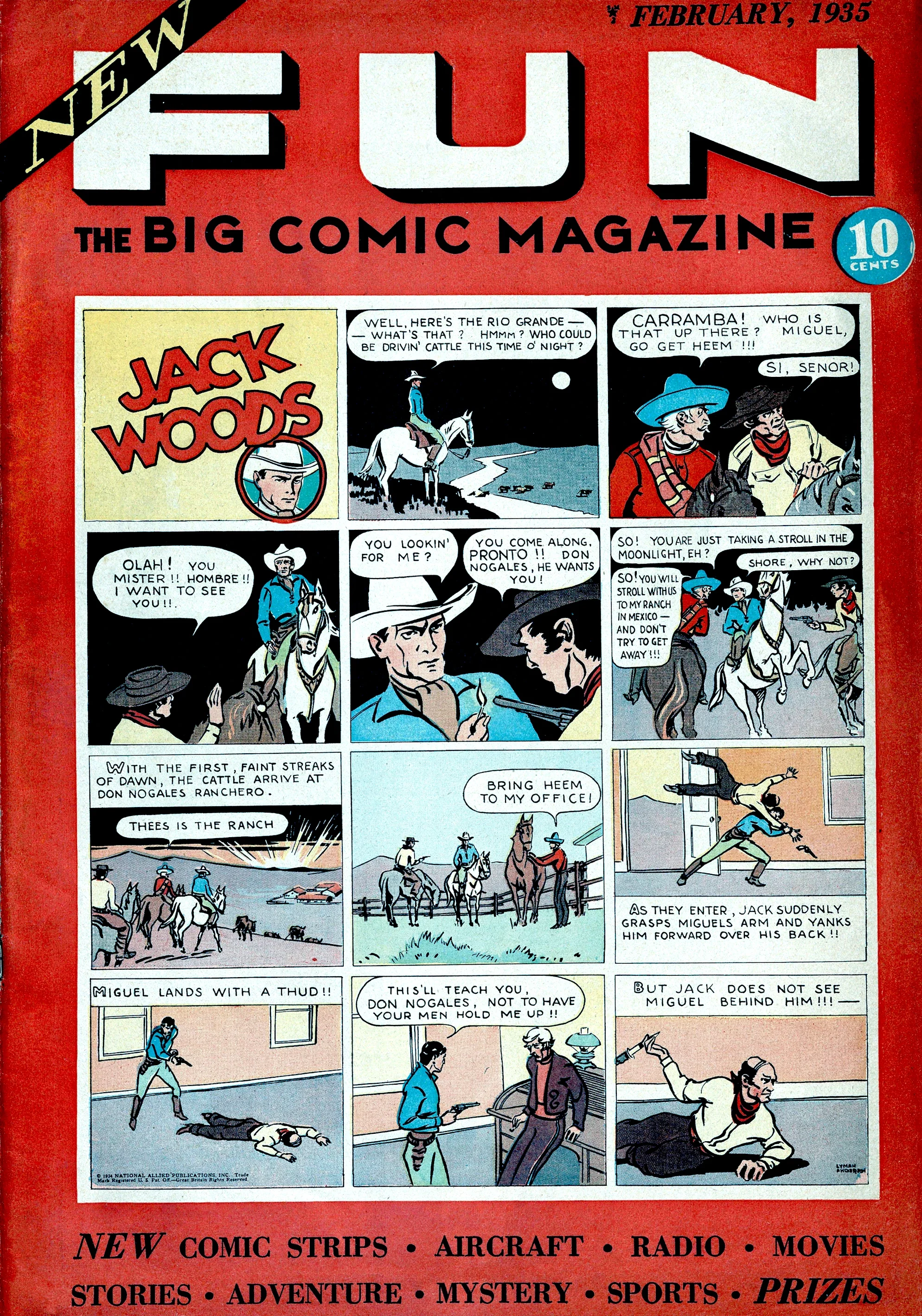
In 1935, Major Malcolm Wheeler-Nicholson, through his company National Allied Publications, launched New Fun.
The publication was an important step towards comic books featuring material created specifically for the format rather than simply reproducing newspaper strips.
National Allied would become part of the publishing lineage that eventually developed into DC Comics.
This was an important change.
Publishers could now create characters specifically for comic book readers.
They could develop original stories, establish continuing adventures and build new publishing properties.
The next stage was the arrival of a character who would transform the medium.
1938: Superman Changes Everything
In 1938, Action Comics #1 introduced Superman, created by writer Jerry Siegel and artist Joe Shuster.
Published by Detective Comics, Inc., part of the corporate lineage of modern DC Comics, the issue carried a cover price of ten cents.
The publication is generally considered the beginning of the Golden Age of American superhero comic books.
Superman wasn't the first comic character.
He wasn't the first costumed adventurer.
But his popularity demonstrated the enormous commercial potential of original superhero characters.
Other publishers quickly recognised the opportunity.
Batman appeared in Detective Comics #27 in 1939.
Captain Marvel, later known as Shazam, appeared in Whiz Comics #2, cover-dated February 1940, from Fawcett Publications.
Captain America debuted in Captain America Comics #1, cover-dated March 1941, published by Timely Comics, an early predecessor of Marvel Comics.
The industry had moved well beyond reprinting newspaper humour.
Comic books now had their own characters, stories, creative teams and rapidly expanding audiences.
And, most importantly for publishers, they had customers willing to return every month.
From Ten-Cent Entertainment to Million-Dollar Collectibles
There's another interesting aspect of this history.
Those earliest comic books weren't manufactured to become collectibles.
They were inexpensive entertainment, printed on relatively poor-quality paper and distributed for everyday reading.
Children folded them, rolled them up, shared them with friends and sometimes threw them away.
Parents discarded them. Paper drives removed millions of printed publications from circulation, particularly during wartime.
Preservation wasn't generally the priority.
Which brings us to the modern collecting market.
Many of the comic books that survived from the Golden Age are now valuable precisely because so many others didn't.
Today, collectors study surviving populations through tools such as the CGC Census and examine documented market activity through services including GPAnalysis.
Condition, rarity, historical significance and collector demand all influence prices.
A comic book originally purchased for ten cents may now sell for thousands, hundreds of thousands or even millions of dollars.
Of course, scarcity alone doesn't guarantee value. A comic also needs sufficient collector demand.
But the contrast between the original purpose of these books and their current status is extraordinary.
The people behind The Funnies and Famous Funnies were trying to build a viable publishing business.
They weren't creating investment assets.
They were selling stories.
The First Comic Book Buyer: A Collector Without Knowing It?
We may never know who bought the very first comic book.
Perhaps it was an adult attracted by a humorous illustration.
Perhaps it was a child who had saved enough money to purchase a publication filled with colourful characters.
Perhaps the buyer finished reading it and immediately passed it to a friend.
Or perhaps, somewhere along the way, that first buyer placed the comic in a drawer and forgot about it.
What we do know is that the comic book industry developed through the efforts of artists, printers, newspaper publishers, entrepreneurs and retailers who recognised the commercial possibilities of illustrated storytelling.
William Heath helped establish an early periodical form of comics in Scotland.
Rodolphe Töpffer demonstrated the power of sequential visual storytelling.
George Delacorte and Dell Publishing experimented with selling original comic-strip publications.
Harry Wildenberg and Max Gaines helped transform newspaper reprints into a new commercial product.
Eastern Color Printing demonstrated that the modern comic book could become a sustainable publishing business.
And Siegel and Shuster, together with the publishers who brought Superman to market, helped establish an entirely new category of popular entertainment.
Each contributed something different.
And without those early experiments, the comic book market we know today might never have existed.
The next time you examine a Golden Age comic, particularly one from the 1930s, consider what its original owner thought they were buying.
It certainly wasn't a future CGC 9.8 investment or a rare addition to a carefully curated collection.
It was probably just ten cents' worth of entertainment.
Almost two hundred years after The Glasgow Looking Glass, that simple idea has become an extraordinary part of popular culture.
And perhaps that's the most interesting thing about comic book history.
The first comic book buyer wasn't trying to make history. They were just buying something they wanted to read.
Historical references and research notes
Glasgow Life and the University of Glasgow: Historical research on The Glasgow Looking Glass, William Heath, John Watson and the publication's origins in 1825.
Guinness World Records: Rodolphe Töpffer and the disputed origins of the earliest comic narrative.
Grand Comics Database: Bibliographic records for The Funnies #1 (1929), including its publication date, price, contributors and original publisher.
Comics scholarship: The development of Eastern Color Printing, Funnies on Parade, Famous Funnies and their commercial significance.
American Library Association and Toronto Metropolitan University: Historical comics readership statistics, including surveys of boys and girls in the 1940s.
Library of Congress: The Golden Age and the historical importance of Action Comics #1.